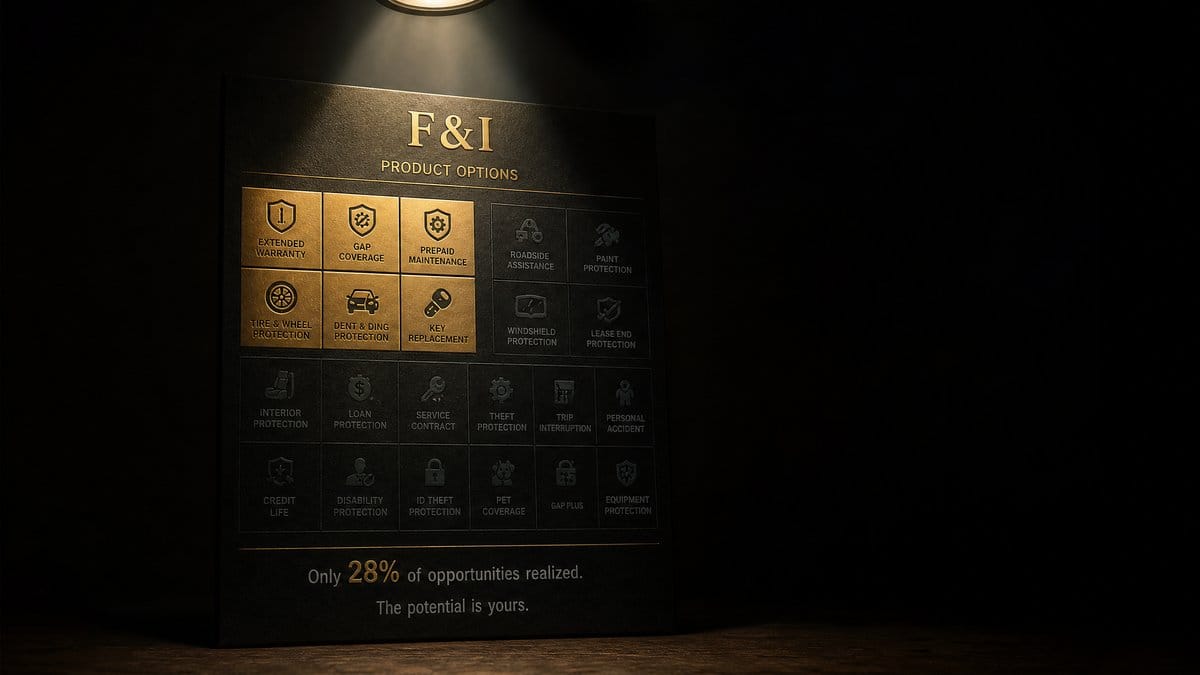

The mid-year mark isn't just a date on the calendar; it's the ultimate reality check for your F&I performance. If you are not running a mid-year performance review on yourself, you are flying blind into the second half of the year, hoping that variance works in your favor instead of actively managing your outcomes.
Here's the deal: June is the halfway mark. The numbers you have posted so far are not a coincidence. They are the direct result of the system you are running, the process you are executing, and the discipline you are applying to every single deal. If your PVR is down, it's not the market. If your penetration rates are slipping, it's not the customers. It's the architecture of your presentation and your adherence to the process. The reality is, elite F&I managers don't wait for their dealer principal to tell them they are off pace. They audit themselves. They look at the scoreboard, they diagnose the structural issues, and they install the necessary corrections before July 1st.
The Reality of the Mid-Year Mark
Let's get one thing straight right out of the gate. The mid-year review is not about making excuses. It's about looking at the raw data and understanding what it's telling you about your execution discipline. Industry benchmarks show that F&I managers who conduct a rigorous self-audit at the six-month mark improve their second-half PVR by an average of 18%. That's not a coincidence. That's the result of targeted, structural adjustments based on actual performance data.
When you look at your numbers, you need to ask yourself: Can you help me understand why my service contract penetration dropped in May? Can you help me understand why my GAP numbers are inconsistent? The answers are always in the process. If you are relying on individual talent or charm to sell protections, you will always be a victim of variance. If you are relying on a locked-in system, you will produce consistent, predictable results.
This isn't semantic. It's structural. The difference between a $1,500 PVR and a $2,500 PVR is not the customer base. It's the architecture of the presentation. It's the Menu Order System. It's the Upgrade Architecture. It's the Objection Prevention Framework. If you are not executing these pillars with precision, your numbers will reflect that lack of discipline.
Auditing Your Penetration Rates
The first step in your mid-year self-audit is a deep dive into your penetration rates. Penetration is the ultimate indicator of product adoption and process effectiveness. If your numbers are low, it means your presentation is flawed. It means you are not building value, you are not transferring trust, and you are not preventing objections before they arise.
Look at your core protections: Vehicle Service Contracts (VSC), GAP, Tire & Wheel, and Maintenance. Where are you strong? Where are you weak? More importantly, why? If your VSC penetration is solid but your GAP is lagging, you need to look at how you are framing the GAP conversation. Are you waiting for the customer to object, or are you proactively addressing the negative equity epidemic in your opening statement?
Here's the thing: You cannot fix what you do not measure. You need to track your penetration rates by product, by lender, and by vehicle type. Are you struggling to sell protections on electric vehicles? Then you need to adapt your EV F&I products presentation. Are you losing deals to credit unions? Then you need to refine your lender relationship playbook.
Analyzing PPD and PVR Trends
Products Per Deal (PPD) and Per Vehicle Retail (PVR) are the scoreboards of F&I. They tell you exactly how effective you are at maximizing the revenue opportunity on every single transaction. But looking at a single month's number is not enough. You need to analyze the trend over the first six months of the year.
Is your PVR trending up, trending down, or flatlining? If it's flatlining, you have hit a plateau in your skill level and your process execution. You need a structural change to break through to the next level. If it's trending down, you have a serious execution problem that needs immediate correction. If it's trending up, you need to identify exactly what is driving that growth and double down on it.
The biggest thing is understanding the relationship between PPD and PVR. You can have a high PVR with a low PPD if you are just holding rate, but that is not a sustainable, long-term strategy. True elite performance comes from a high PPD, which means you are selling multiple protections on every deal. That requires a flawless Menu Order System and a disciplined approach to the upgrade architecture.
Evaluating Process Adherence
Process adherence is the glue that holds your F&I performance together. You can have the best scripts, the best tools, and the best intentions, but if you do not execute the process with precision on every single deal, you will fail. The mid-year review is the time to brutally assess your adherence to the core pillars of the ASURA OPS system.
Are you conducting a proper client survey on every deal? The client survey is the diagnostic tool that creates awareness and transfers trust. If you are skipping it, you are flying blind into the menu presentation. Are you using the base payment anchor correctly? It must be stated as a statement, not a question. Are you executing the Objection Prevention Framework, or are you falling back into reactive objection handling?
This is what works: 100% process adherence, 100% of the time. Variance is the enemy of F&I performance. When you deviate from the process, you introduce variance. When you introduce variance, your numbers suffer. It's that simple. Your mid-year audit must identify where you are deviating from the process and put a hard stop to it.
The Importance of Coaching Cadence Consistency
You cannot maintain elite performance in isolation. You need a consistent coaching cadence to keep you locked in, focused, and executing at the highest level. The mid-year review is the perfect time to evaluate your coaching rhythm. Are you engaging in a 15-minute weekly coaching cadence, or are you just winging it month to month?
Coaching is not training. Training is an event; coaching is a process. Training teaches you what to do; coaching ensures you actually do it. If your numbers are slipping, it's not because you forgot how to sell. It's because your execution discipline has eroded. A consistent coaching cadence prevents that erosion. It keeps the process top of mind and ensures that you are constantly refining your skills.
Look, if you are a dealer principal or an F&I director, you need to look in the mirror. Are you providing the coaching your team needs to succeed? Are you holding them accountable to the process, or are you just yelling at them when the numbers are down? The reality is, systems produce results, not individuals. If your system does not include a rigorous coaching cadence, you are setting your team up for failure.
Mid-Year Performance Audit Checklist
To make this actionable, here is the exact checklist you need to run on yourself for your mid-year performance review. Do not skip a single step. Be brutally honest with yourself. The numbers do not lie.
| Performance Metric | Target Benchmark | Your Current Average (Jan-Jun) | Variance / Gap | Action Plan for Q3/Q4 |
|---|---|---|---|---|
| Per Vehicle Retail (PVR) | $2,500+ | [Fill in your number] | [Calculate difference] | [Identify structural fix] |
| Products Per Deal (PPD) | 2.5+ | [Fill in your number] | [Calculate difference] | [Identify structural fix] |
| VSC Penetration | 65%+ | [Fill in your number] | [Calculate difference] | [Identify structural fix] |
| GAP Penetration | 45%+ | [Fill in your number] | [Calculate difference] | [Identify structural fix] |
| Menu Presentation Rate | 100% | [Fill in your number] | [Calculate difference] | [Identify structural fix] |
This table is your roadmap for the second half of the year. It tells you exactly where you are bleeding revenue and exactly what you need to fix. If your VSC penetration is below 65%, you have a structural problem with your value build. If your Menu Presentation Rate is anything less than 100%, you have a massive discipline problem.
The Anatomy of a Broken Process
When we look at national data, the anatomy of a broken F&I process is always the same. It starts with a lack of preparation. The F&I manager doesn't do a quick scan of the numbers; they spend ten minutes over-analyzing the credit profile, trying to pre-judge what the customer will buy. That is a massive mistake. You do not need the vehicle specs, the lender details, or the credit profile breakdown to run your process. All you need are the numbers they agreed to and the client survey. Grab the numbers, go get the customer, and process them. Handle the rest from inside the box.
The next failure point is the opening statement. If you are opening your deals with weak, passive language, you are immediately surrendering control of the transaction. The first thirty seconds dictate the outcome of the next thirty minutes. You must use a strong, definitive opening that establishes your authority and sets the agenda. You are not there to ask for permission; you are there to run a process.
Then comes the menu presentation. This is the sacred process. If you are skipping steps, if you are rushing through the protections, if you are not using the base payment anchor correctly, you are destroying your own credibility. The Menu Order System is designed to logically and systematically build value. When you deviate from it, you confuse the customer. And a confused customer always says no.
Mastering the Client Survey
Let's talk about the client survey. This is not a piece of paper you hand the customer to keep them busy while you print forms. The client survey is the diagnostic tool that creates awareness. It is the foundation of your entire presentation. If you are not using it correctly, you are leaving thousands of dollars on the table.
The reality is, customers do not buy protections because they want them; they buy them because they realize they need them. The client survey is how you help them realize that need. By asking targeted, strategic questions about their driving habits, their ownership timeline, and their risk tolerance, you are proactively identifying the gaps in their coverage. You are setting up the Objection Prevention Framework before you even present the menu.
When you review the client survey with the customer, you must do it with precision. You are not just reading their answers back to them; you are confirming their reality. "I see here that you drive 15,000 miles a year and plan to keep the vehicle for six years. Does that make sense?" You are getting them to agree to the facts, which makes it infinitely easier to present the logical solutions later in the process.
The Upgrade Architecture in Action
One of the biggest areas where F&I managers fail during the second half of the year is in their upgrade strategy. They present the menu, the customer picks the basic option, and the manager just accepts it and moves on. That is not how elite operators function. Elite operators use a standardized Upgrade Architecture to move customers up without pressure.
The Upgrade Architecture is about logical progression. It's about showing the customer the incremental value of the next level of protection. You don't ask them if they want to upgrade; you show them why it makes sense to upgrade. "Based on what you told me in the client survey about your driving habits, the comprehensive coverage is actually a better fit for your specific situation. Here's why..."
This requires exact words, exact sequence, and exact timing. You cannot fumble through the upgrade conversation. You must be smooth, confident, and authoritative. If your PPD is stuck at 1.5, it's because your Upgrade Architecture is broken. You need to drill this in your weekly coaching cadence until it becomes second nature.
Preventing Objections Before They Happen
Let's get one thing perfectly clear: objection handling is a myth. If you are handling objections, you have already lost control of the process. The goal is objection prevention. You must anticipate the common objections—price, need, outside financing—and dismantle them before the customer even has a chance to articulate them.
This is where the Objection Prevention Framework comes in. It is a proactive, structural approach to the presentation. When you use the base payment anchor correctly, you eliminate the price objection. When you use the client survey correctly, you eliminate the need objection. When you control the sequence of the presentation, you eliminate the outside financing objection.
Not because the customers are lazy. Because you have logically and systematically removed every reason for them to say no. You have built a bulletproof case for the protections you are offering. If you are constantly fighting objections in the box, your mid-year review needs to focus heavily on reinstalling the Objection Prevention Framework.
The Role of the Dealer Principal
I want to speak directly to the dealer principals and general managers for a minute. Your F&I department's performance is a direct reflection of your leadership. If your F&I managers are underperforming at the mid-year mark, it is your responsibility to fix the system. You cannot just fire your way to a $2,500 PVR. You must install a process.
Are you holding your team accountable to the ASURA OPS Four Pillars? Are you ensuring that the 15-minute weekly coaching cadence is happening every single week without fail? Are you inspecting what you expect? If the answer is no, then you are complicit in the underperformance.
The reality is, systems produce results, not individuals. You need to build an architecture that supports elite performance. You need to provide the tools, the training, and the coaching necessary for your team to succeed. If you do that, the numbers will follow. If you don't, you will be having this exact same conversation at the end of the year.
Deep Dive: The Base Payment Anchor
Let's drill down into one of the most critical, yet frequently misunderstood, components of the presentation: the base payment anchor. This is not a suggestion. It is a structural requirement. The base payment anchor must be stated as a statement, not a question. When you ask, "Is this payment okay?" you are inviting an objection. When you state, "Here is your base payment," you are establishing a fact.
This subtle shift in language completely changes the dynamic of the conversation. It removes the negotiation from the F&I office and focuses the customer's attention on the protections being offered. If your mid-year audit reveals that you are struggling with price objections, I guarantee you are messing up the base payment anchor.
You must practice this until it is flawless. It requires execution discipline. You cannot let your tone waver. You cannot add filler words. You state the payment, you pause, and you move directly into the menu presentation. That is what works. That is how you maintain control.
The Psychology of the Elite Operator
Finally, we need to talk about identity. The difference between a $1,500 PVR manager and a $2,500 PVR manager is not just process; it's psychology. Elite operators have a fundamentally different identity. They view themselves as financial professionals, not salespeople. They view their role as protecting the customer, not just selling products.
This identity drives their behavior. It gives them the confidence to hold the line on process adherence. It gives them the discipline to execute the coaching cadence week in and week out. It gives them the resilience to bounce back from a bad deal and execute the next one flawlessly.
During your mid-year review, you need to audit your own psychology. Are you operating with the mindset of an elite, Tier-1 operator? Or are you letting the daily grind wear you down? You must protect your mindset as fiercely as you protect your process. Because at the end of the day, your identity determines your execution, and your execution determines your results.
Rebuilding the Foundation for Q3 and Q4
As you move into the third and fourth quarters, your focus must be on structural consistency. You have identified the gaps in your performance. You have built your action plan. Now you must execute. This is not the time for radical experimentation. This is the time for ruthless adherence to the proven system.
Every single deal must follow the exact same architecture. Quick scan of the numbers. Strong opening statement. Thorough client survey review. Flawless Menu Order System. Proactive Objection Prevention Framework. Logical Upgrade Architecture. This is the formula for predictable, elite performance.
Do not let variance creep back into your process. When you feel yourself drifting, lean on your coaching cadence to pull you back to center. The second half of the year is where championships are won. It's where the elite separate themselves from the average. Make the decision today to be elite. Install the system, execute the process, and dominate the rest of the year.
The Impact of Market Conditions on F&I
Let's address the elephant in the room: market conditions. Yes, interest rates are fluctuating. Yes, vehicle prices are high. Yes, consumer confidence is shifting. But here is the thing: elite F&I managers do not use market conditions as an excuse for poor performance. They adapt their process to the reality of the market.
When affordability becomes a primary concern for the consumer, your Objection Prevention Framework must adapt. You must become an expert at demonstrating the long-term value of protections versus the short-term cost. You must clearly articulate how a Vehicle Service Contract protects their monthly budget from catastrophic repair bills. You must explain how GAP coverage shields them from the devastating financial impact of a total loss in a volatile equity market.
This is not about high-pressure sales tactics; it is about financial education. The pragmatic buyer needs logical, data-driven reasons to invest in protections. Your presentation architecture must provide those reasons clearly and concisely. If your numbers are down because you are blaming the market, your mid-year review needs to be a wake-up call. The market is the market. Your process is what you control.
Leveraging Technology in the F&I Process
In 2026, technology is deeply integrated into the F&I workflow. Digital retailing tools, electronic menus, and automated compliance systems are standard. However, technology is a tool, not a strategy. If you overlay advanced technology on top of a broken process, you just fail faster.
Your mid-year audit must include an evaluation of how you are using your technology stack. Are your electronic menus configured to support the Menu Order System, or are they creating confusion? Are you using digital tools to enhance the client survey, or are they replacing the critical human interaction needed to transfer trust?
The reality is, technology should streamline the transaction and ensure compliance, but it cannot replace the structural consistency of a well-executed presentation. You must master the technology so that it operates seamlessly in the background, allowing you to focus 100% of your attention on the customer and the process.
Building a Culture of Accountability
For F&I directors and dealership leadership, the mid-year review is also an audit of your departmental culture. Is your F&I department a culture of accountability, or a culture of excuses? Accountability means that every team member is responsible for their process adherence and their results.
A culture of accountability is built on transparency. The scoreboard must be visible to everyone. PVR, PPD, and penetration rates should be reviewed openly during the weekly coaching cadence. This is not about shaming underperformers; it is about identifying areas for improvement and providing the necessary support to elevate the entire team.
When you establish a culture where structural consistency is the standard and variance is unacceptable, you create an environment where elite performance thrives. Your mid-year review must assess whether you are fostering this culture or allowing mediocrity to take root.
The Long-Term ROI of Process Discipline
I want to make sure we look at the big picture. The discipline you apply to your process today does not just impact this month's paycheck; it compounds over time. The long-term ROI of process discipline is staggering. When you consistently execute the ASURA OPS system, you build a reputation for excellence. You earn the trust of your lenders, which leads to better approvals. You earn the respect of your sales team, which leads to smoother turnovers.
Most importantly, you build a sustainable career. You are no longer riding the emotional rollercoaster of variance. You have a predictable, reliable system that generates high-level income year after year. That is the ultimate goal. That is what it means to be a Tier-1 operator.
So, as you complete your mid-year performance review, remember that you are not just fixing a few numbers on a spreadsheet. You are reinforcing the foundation of your professional success. You are committing to the discipline required to be the best in the business.
Final Thoughts on Execution
Execution is everything. You can read every blog post, attend every seminar, and memorize every script, but if you do not execute in the box, it means nothing. The mid-year review gives you the clarity you need to execute with precision.
Take the data from your self-audit. Build your action plan. Reinstall the core pillars. Lock in your coaching cadence. And then go execute. The second half of the year is yours for the taking. Do not leave it to chance. Control the process, control the outcome.
Executing the Turnaround
So if you have identified the gaps in your performance, what happens next? What happens when you realize that your process is broken and your numbers are suffering? You execute a turnaround. You don't wait for next month. You don't wait for the next training seminar. You fix it today.
The first step in the turnaround is resetting your identity. Who you are determines what you do. If you identify as an elite, Tier-1 operator, you will execute the process with precision. If you identify as an average order-taker, you will continue to produce average results. You must make the decision to be elite.
The second step is reinstalling the core pillars of the ASURA OPS system. Go back to the basics. Review the Menu Order System. Practice the Upgrade Architecture. Roleplay the Objection Prevention Framework. Lock in your coaching cadence. Do not deviate. Do not improvise. Execute the system.
The Cost of Inaction
I want to make sure you understand the stakes here. The cost of inaction is massive. Every deal you process with a broken system is lost revenue that you will never get back. Every customer who leaves your office without the proper protections is a liability for the dealership and a missed opportunity for you.
Let's do the math. If you are running a $1,500 PVR and you process 100 deals a month, your department is generating $150,000 in gross. If you fix your process and increase your PVR to $2,500, you are now generating $250,000 in gross. That is a $100,000 difference every single month. That is $1.2 million a year. That is the cost of a broken process.
Does that make sense? You cannot afford to ignore your mid-year performance review. The numbers are too big. The stakes are too high. You must take control of your process, audit your performance, and execute the necessary corrections.
Key Takeaways
- The mid-year review is a mandatory reality check for elite F&I managers to audit their performance and process adherence.
- Penetration rates are the ultimate indicator of process effectiveness; low numbers mean your presentation architecture is flawed.
- PVR and PPD trends must be analyzed over the six-month period to identify structural issues and execution gaps.
- 100% process adherence is required to eliminate variance and produce consistent, predictable results.
- A consistent coaching cadence is essential to maintain execution discipline and prevent performance erosion.
- The cost of inaction is massive; a broken process costs the dealership hundreds of thousands of dollars in lost revenue.
- Reinstalling the core pillars of the ASURA OPS system is the only way to execute a successful turnaround in the second half of the year.
Frequently Asked Questions
Why is the mid-year review so critical for F&I managers?
The mid-year review is critical because it provides a data-driven reality check at the halfway point of the year. It allows F&I managers to identify structural flaws in their process, correct execution gaps, and implement targeted adjustments before the year is over, ensuring they hit their annual performance targets.
What are the most important metrics to analyze during the mid-year audit?
The most important metrics are Per Vehicle Retail (PVR), Products Per Deal (PPD), core product penetration rates (VSC, GAP, Maintenance), and the Menu Presentation Rate. These metrics provide a comprehensive picture of process effectiveness and execution discipline.
How can I improve my penetration rates if they are slipping?
Improving penetration rates requires a structural adjustment to your presentation architecture. You must ensure you are executing the Menu Order System flawlessly, utilizing the Objection Prevention Framework proactively, and conducting a thorough client survey on every deal to build value and transfer trust.
What is the difference between training and coaching in F&I?
Training is an event that teaches you what to do; coaching is an ongoing process that ensures you actually do it. A consistent coaching cadence is required to maintain execution discipline, prevent variance, and keep the core processes top of mind.
How do I fix a flatlining PVR trend?
A flatlining PVR indicates a plateau in skill and process execution. To break through, you need a structural change. This often involves refining your Upgrade Architecture, mastering the base payment anchor, and ensuring 100% adherence to the ASURA OPS core pillars.
Why is variance considered the enemy of F&I performance?
Variance introduces unpredictability and inconsistency into the F&I process. When you deviate from the standardized system, you rely on individual talent rather than a proven architecture, which inevitably leads to fluctuating numbers and lost revenue.
What should I do if my dealership does not provide a consistent coaching cadence?
If your dealership lacks a coaching cadence, you must take ownership of your own development. Seek out external coaching, utilize self-audit tools, and rigorously hold yourself accountable to the process. Elite operators do not wait for someone else to manage their success.
How does the ASURA OPS system guarantee results?
The ASURA OPS system guarantees results by replacing individual variance with structural consistency. By locking in the Menu Order System, Upgrade Architecture, Objection Prevention Framework, and Coaching Cadence, it creates a predictable, repeatable process that maximizes revenue on every deal.
Take Control of Your Second Half
The mid-year mark is here. The numbers are what they are. You can either make excuses, or you can make adjustments. If you are ready to stop relying on variance and start executing a proven system, it's time to step up. Stop guessing. Stop hoping. Start executing. If you want to install the architecture that guarantees elite performance, get into the ASURA coaching ecosystem today. We don't do theory. We do what works.