
The $2,627 Wake-Up Call for Single-Point Dealers
If you are sitting in a single-point dealership right now, staring at a $1,800 PVR and wondering why it feels like you are pushing a boulder up a hill, I have a number for you. $2,627. That is the average F&I PVR for publicly traded dealer groups in Q1 2026, according to the latest Haig Partners data. That is up 4%—or $109—from the previous quarter. More importantly, F&I's share of average revenue per vehicle retailed just hit 6.4%. Let that sink in. While the rest of the industry is complaining about margin compression, inventory constraints, and interest rates, the big boys are printing money in the box.
I have been in this business for over two decades. I have seen the cycles. I have seen the excuses. But the data does not lie. The gap between the publicly traded giants and the independent operators is widening, and it is not because they have better products or magic lenders. It is because they have a system. They have a process that scales, and they execute it with ruthless consistency. If you are not paying attention to what they are doing, you are leaving hundreds of thousands of dollars on the table every single month.
This is not about motivation. This is about mechanics. The publicly traded groups understand that F&I is not an afterthought; it is the profit engine of the dealership. They do not rely on the individual brilliance of a single F&I manager. They rely on an architecture that forces high performance. If you want to close the gap, you need to stop treating F&I like an art form and start treating it like a science. Let's break down exactly what these groups are doing differently and how you can steal their playbook.
The first thing you need to understand is that the $2,627 PVR is not an accident. It is the result of a relentless focus on process adherence. When you have hundreds of rooftops, you cannot afford to have rogue managers doing things their own way. You need a standardized approach that works every time, regardless of who is sitting in the chair. This is where most single-point dealers fail. They hire a "superstar" and let them run wild, hoping the numbers hold up. But what happens when that superstar leaves? The numbers tank. The big groups do not play that game. They build a system that outlasts any individual.
If you are serious about hitting that $2,600+ mark, you need to start by auditing your current process. Are your managers presenting 100% of the products to 100% of the customers 100% of the time? If the answer is no, you have found your first leak. You can read more about how to fix this in our guide on the F&I performance process problem. The bottom line is that consistency is the foundation of high PVR. Without it, you are just guessing.
The Architecture of a $2,600+ PVR
Let's get into the weeds. What does the architecture of a $2,627 PVR actually look like? It starts long before the customer ever steps foot in the F&I office. The publicly traded groups have mastered the art of the seamless transition. They know that the deal is won or lost in the handoff. If the sales team is not setting the table correctly, the F&I manager is starting from a deficit. This is why the big groups mandate a structured introduction. The F&I manager does not just wait for the folder to drop on their desk; they are involved early. They are doing a pre-deal scan in 60 seconds to identify opportunities and landmines before the customer even knows they are going into the box.
Once the customer is in the office, the presentation is not a negotiation; it is an education. The big groups use a highly structured menu presentation that anchors the customer to a base payment and builds value from there. They do not ask, "Do you want an extended warranty?" They say, "Here is how we are going to protect your investment." It is a subtle shift in language, but it makes a massive difference in penetration rates. If you are still using the old-school step-selling method, you are getting left behind. You need a menu order system that drives PVR.
Another critical component of this architecture is the way they handle objections. The publicly traded groups do not train their managers to overcome objections; they train them to prevent them. They use a structured objection prevention framework that addresses the customer's concerns before they even articulate them. By the time the customer sees the menu, the value proposition has already been established. The objections are minimized, and the close rate skyrockets.
But the real secret sauce is the accountability. In a publicly traded group, the numbers are scrutinized daily. If a manager's PVR drops, it is flagged immediately. There is no hiding. There is no waiting until the end of the month to see how things shook out. The intervention happens in real-time. This level of accountability forces managers to stay sharp. It forces them to adhere to the process. If you are running a single-point store, you need to implement this same level of daily scrutiny. You cannot manage what you do not measure.
Finally, the architecture includes a relentless focus on training. The big groups do not just train their managers once and expect them to perform at a high level forever. They have a continuous coaching cadence. They are role-playing daily. They are reviewing deals weekly. They are constantly refining the process. If you are not investing in continuous training, you are falling behind. You need a coaching cadence system that keeps your team sharp and focused on the metrics that matter.
The Product Mix That Drives the Number
You do not hit $2,627 PVR by just selling more of the same. You hit it by optimizing your product mix. The publicly traded groups have figured out exactly which products drive the most profit and how to package them in a way that makes sense to the consumer. They are not just throwing spaghetti at the wall to see what sticks. They have a deliberate strategy for every single deal.
First and foremost, they are dominating the Vehicle Service Contract (VSC) penetration. This is the anchor product. If you are not hitting at least 55-60% VSC penetration, you are not even in the game. The big groups know that the VSC is not just a profit center; it is a retention tool. They train their managers to present the VSC not as an option, but as a necessity. They use real-world repair costs to build the value proposition. They do not sell peace of mind; they sell financial protection against catastrophic failure.
Next is GAP. With the current state of vehicle pricing and the negative equity epidemic, GAP should be an easy sell. But the big groups do not just rely on the obvious need. They have a structured GAP conversation that works every time. They show the customer exactly what happens if they total the car in year two. They make the risk tangible. If your GAP penetration is hovering around 30%, you are doing it wrong. The big groups are pushing 45-50% consistently.
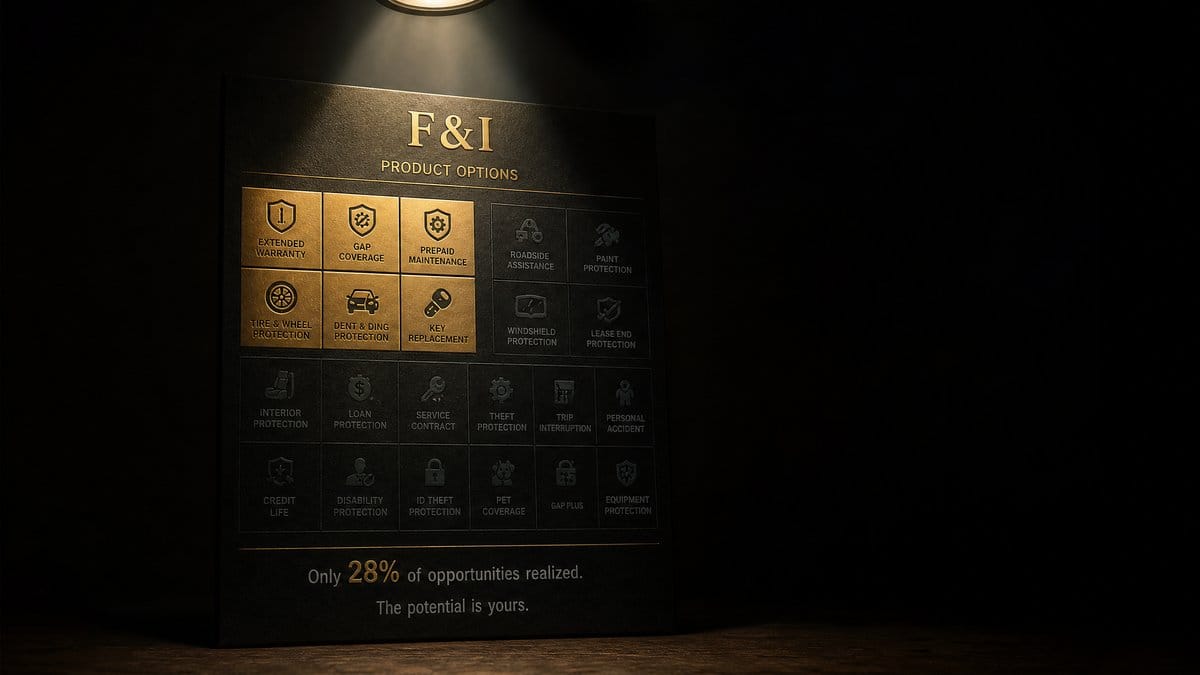
But the real differentiator in the product mix is the ancillary products. Tire and Wheel, Key Replacement, Paint and Fabric Protection. These are the high-margin products that push the PVR over the edge. The publicly traded groups do not treat these as throw-ins. They package them intelligently. They create bundles that make sense for the specific vehicle and the specific customer. They do not just offer a menu of a la carte options; they offer comprehensive protection packages.
They also understand the power of the base payment anchor. By establishing a strong base payment early in the process, they create room to add these ancillary products without blowing up the customer's budget. It is a psychological game, and the big groups play it better than anyone else. They know how to stretch the customer's perceived affordability while delivering real value.
If you want to replicate this product mix, you need to start by analyzing your current penetrations. Where are you weak? Where are you leaving money on the table? Once you identify the gaps, you need to train your team on how to present those specific products more effectively. You cannot just tell them to sell more; you have to show them how. You have to give them the word tracks and the frameworks that actually work in the box.
The Role of Technology and Data
You cannot talk about the success of the publicly traded groups without talking about technology and data. These organizations are not running their F&I departments on gut instinct and whiteboards. They are using sophisticated data analytics to drive every decision. They know exactly what their PVR should be on every single deal based on the vehicle, the lender, and the customer profile. They are not guessing; they are executing a mathematical formula.
One of the biggest advantages they have is the ability to benchmark performance across hundreds of stores. If a manager in Texas is crushing it with a specific product bundle, that data is immediately shared across the entire network. The best practices are institutionalized instantly. In a single-point store, you are operating in a vacuum. You only know what you know. This is why you have to be proactive about seeking out industry data and benchmarking your performance against the best in the business.
The big groups are also leveraging technology to streamline the process. They are using digital menus, e-contracting, and automated compliance checks to speed up the transaction and reduce errors. This not only improves the customer experience but also frees up the F&I manager to focus on selling rather than paperwork. If your managers are spending half their time chasing stips and fixing contracts, they are not selling. You need to invest in the technology that allows them to do their job efficiently.
But technology is only as good as the data you feed it. The publicly traded groups are obsessive about data integrity. They track every single metric. They know their presentation rate, their close rate by product, their profit per product, and their chargeback rate. They use this data to identify coaching opportunities and hold their managers accountable. If you are not tracking these 5 KPIs that predict F&I performance, you are flying blind.
The future of F&I is data-driven. The days of the charismatic closer who wings it every time are over. The new breed of F&I manager is a data analyst who understands how to use information to maximize profit. If you want to compete with the big groups, you need to adopt this mindset. You need to start treating your F&I department like a financial institution, not a used car lot. You need to use data to drive your strategy and technology to execute it.
The Culture of High Performance
All the processes, products, and technology in the world will not save you if you do not have the right culture. The publicly traded groups understand this better than anyone. They do not just hire F&I managers; they build high-performance teams. They create an environment where excellence is the expectation, not the exception. This is the hardest part to replicate, but it is also the most important.
It starts with the pay plan. The big groups structure their pay plans to incentivize the behavior they want. They do not just pay a flat percentage of the gross. They use tiered structures that reward high PVR and high product penetration. They penalize chargebacks and compliance violations. They align the manager's financial interests with the dealership's goals. If your pay plan is outdated, you are incentivizing mediocrity. You need an F&I pay plan structure that incentivizes growth.
But it is not just about the money. It is about the environment. The publicly traded groups foster a culture of continuous improvement. They celebrate the wins, but they also dissect the losses. They do not accept excuses. If a manager misses their numbers, the conversation is not about the market or the lenders; it is about the process. What step did you skip? What objection did you fail to handle? This level of accountability creates a culture where everyone is constantly striving to get better.
They also invest heavily in leadership. The F&I directors in these groups are not just glorified desk managers; they are coaches. They are on the floor, working with the managers, reviewing deals, and providing real-time feedback. They understand the difference between installation vs training. They do not just tell their team what to do; they show them how to do it and hold them accountable for executing it.
If you want to build this kind of culture in your dealership, you have to start at the top. The dealer principal and the general manager have to be fully committed to the F&I process. They have to demand excellence and provide the resources necessary to achieve it. You cannot build a high-performance culture if the leadership is willing to accept mediocrity. You have to draw a line in the sand and say, "This is the standard, and we will not accept anything less."
The Path Forward for Single-Point Dealers
So, what do you do with this information? You are sitting in a single-point store, looking at that $2,627 PVR, and wondering how you are ever going to get there. The answer is simple, but it is not easy. You have to stop making excuses and start executing. You have to stop looking at the publicly traded groups as the enemy and start looking at them as the blueprint.
The first step is to acknowledge that your current process is broken. If you are not hitting $2,000+ PVR consistently, something is wrong. You need to do a deep dive into your operation. You need an F&I process audit to identify the leaks. Are your managers presenting the menu 100% of the time? Are they handling objections effectively? Are they maximizing the product mix? You have to be brutally honest with yourself about where you are falling short.
Once you have identified the problems, you have to implement the solutions. You have to build a standardized process that forces high performance. You have to train your team on that process until it becomes second nature. You have to hold them accountable for executing it on every single deal. You have to track the metrics and use the data to drive continuous improvement. You have to build a culture of excellence.
This is not going to happen overnight. It takes time, effort, and a relentless commitment to the process. But the payoff is massive. If you can increase your PVR by just $500, what does that do to your bottom line? What does that do to your dealership's valuation? The money is there. The publicly traded groups are proving it every single quarter. The only question is whether you are willing to do the work to go get it.
Stop playing small. Stop accepting mediocrity. The blueprint is right in front of you. It is time to execute. It is time to build an F&I department that prints money, regardless of the market conditions. It is time to step up and claim your share of that $2,627 PVR. The choice is yours. You can keep doing what you are doing and getting the same results, or you can change the game. I know what the big boys are doing. Now, so do you.
Frequently Asked Questions
What is a good F&I PVR target for a single-point dealership in 2026?
While the publicly traded groups hit $2,627 in Q1 2026, a strong target for a high-performing single-point dealership should be consistently above $2,200. Hitting this requires a strict adherence to a standardized menu presentation, a 100% product presentation rate, and a deep understanding of objection prevention. If you are hovering around $1,500 to $1,800, you have significant process leaks that need immediate attention. The gap between average and elite is entirely driven by process execution, not market conditions or customer demographics.
How do publicly traded dealer groups achieve such high F&I PVR?
Publicly traded dealer groups achieve a $2,627 F&I PVR through scale, standardized processes, and ruthless accountability. They do not rely on individual talent; they rely on a rigid architecture. This includes mandatory pre-deal scans, structured menu presentations, real-time performance tracking, and continuous daily coaching. They leverage data across hundreds of rooftops to identify winning product bundles and instantly institutionalize those best practices. Their managers are trained to execute a specific playbook on every single deal without deviation.
Why is VSC penetration so critical to maximizing F&I PVR?
Vehicle Service Contract (VSC) penetration is the anchor of a high F&I PVR because it offers the highest margin and sets the stage for ancillary product sales. Elite F&I departments target a 55-60% VSC penetration rate. By establishing the VSC as a financial necessity rather than an optional add-on, managers create a strong base payment. This base payment anchor allows them to seamlessly package high-margin ancillary products like Tire and Wheel or GAP without exceeding the customer's perceived affordability threshold.
How can a single-point dealer compete with the technology of large groups?
Single-point dealers can compete by maximizing the technology they already have and focusing intensely on data integrity. You do not need a proprietary enterprise system; you need to religiously track the 5 KPIs that predict F&I performance: presentation rate, close rate by product, profit per product, chargeback rate, and VSC penetration. Use digital menus and e-contracting to streamline the process, freeing up your managers to focus on selling. The key is not the cost of the technology, but the discipline to use the data it provides to drive daily coaching.
What is the biggest mistake F&I managers make that hurts PVR?
The biggest mistake F&I managers make is failing to present 100% of the products to 100% of the customers. Skipping steps in the process or pre-judging a customer's willingness to buy immediately kills PVR potential. This often stems from a lack of a standardized menu presentation or a fear of objections. High-performing managers use an objection prevention framework to build value early, ensuring that when the menu is presented, the customer is already primed to see the financial logic of the protection products.