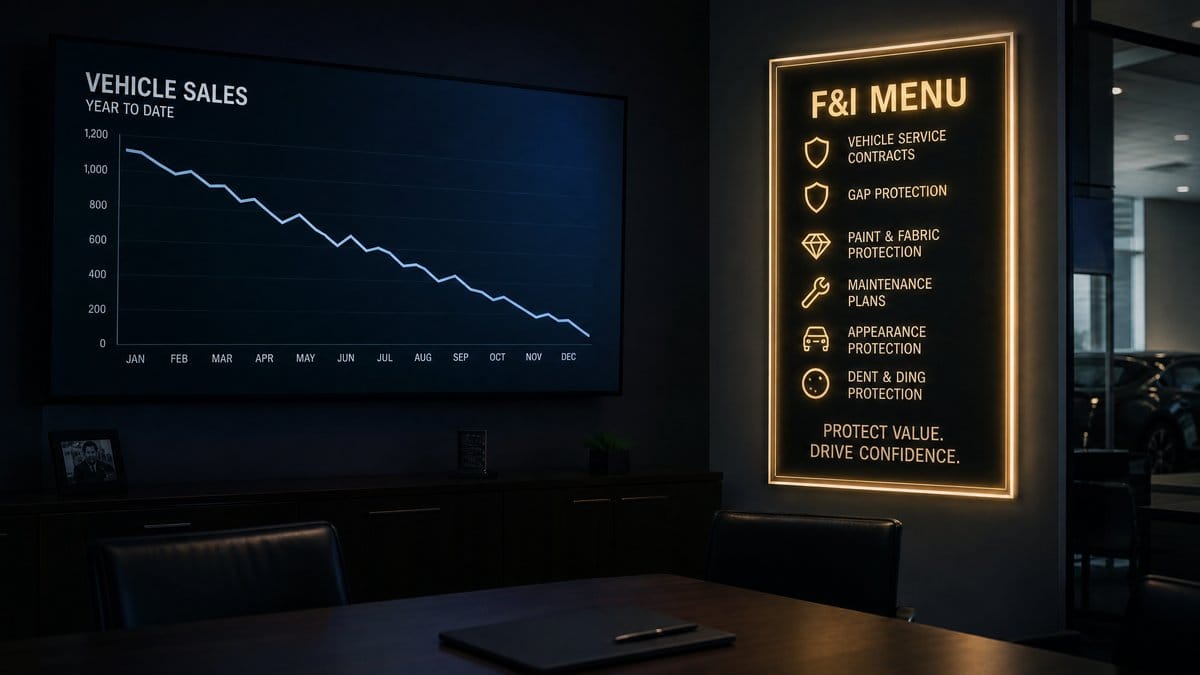

New vehicle sales are up 6% year over year. This is not a drill. The market is heating up, and volume is coming your way. Here’s the deal: more sales mean more chances to boost your F&I revenue. But only if your process holds steady under pressure. Volume without a rock-solid process equals chaos. It creates variance. And variance kills your per-deal revenue. You can’t afford to let that happen.
The reality is this: when sales jump, execution gaps widen. You’ll see fluctuations in penetration rates. PVR will become unpredictable. Your team might feel the heat and start cutting corners. Without structural consistency and execution discipline, you’re leaving money on the table. Here’s the thing—riding the volume wave isn’t about just selling more cars. It’s about maintaining your architecture of protections and coverage installation. It’s about the cadence of your menu presentation and the strength of your base payment anchor plus upgrade architecture. That’s what works.
Imagine this: you’re handling 6% more deals than last year. Your process is tested. The question is, will you let variance creep in? Or will you lock down your system so every deal flows smoothly, every objection is prevented, and every protection is presented with confidence? That’s the difference between riding the wave profitably or wiping out.
Don’t wait for the wave to crash over you. Prepare your F&I operation now. You need a process that scales. One that keeps your team consistent no matter the volume. If you’re not sure your process can handle the heat, start here: Fi Performance Process Problem. Fix the leaks before the flood.
Volume is a massive opportunity. But only if you have the architecture and execution discipline to support it. Control variance. Protect your PVR. Own the process. That’s how you ride the 6% increase without sacrificing per-deal revenue. Does that make sense?
The Volume Trap: Why More Cars Often Means Less PVR
Here’s the thing: more cars don’t automatically mean more profit. The reality is, when volume spikes, your PVR often tanks. Why? Because you rush. You skip steps. You lose structural consistency. This is what kills your F&I performance every time.
Think about it. When you’re slammed with cars, variance skyrockets. Some deals get the full treatment. Others get rushed, half-baked menu presentations. The base payment anchor gets dropped or muddled. Upgrade architecture falls apart. Protections get glossed over or skipped. This inconsistency kills your penetration rates and drags your PVR down below industry benchmarks.
Industry benchmarks show a clear pattern: when volume jumps without a rigid process and execution discipline, PVR can drop by 15% or more. That’s not because the customers don’t want coverage. It’s because your system can’t handle the load. The cadence breaks down. Objection prevention goes out the window. And you leave money on the table.
Here’s the reality—structural consistency is your lifeline. You need a system that holds tight even when volume doubles. That means every deal gets the same installation, the same menu presentation, the same base payment anchor and upgrade architecture. No shortcuts. No variance. This is what works in high-volume environments.
If you’re struggling with this, you’re not alone. Most F&I managers fall into this volume trap. The key is to build a process that scales. You want to protect your PVR even when the lot is slammed. You want execution discipline that doesn’t falter under pressure.
For a deeper dive on how to build a system that supports volume without sacrificing PVR, check out this comparison of PVR systems. It breaks down the architecture you need to win when volume spikes.
Does that make sense? More cars alone won’t save you. You need a proven process. You need structural consistency. You need execution discipline. Nail that, and you’ll crush the volume trap every time.
Process vs. Pressure: The Architecture of High-Volume F&I
Here's the thing: your F&I success isn’t about pressure. It’s not about forcing customers into buying protections. The reality is, high-volume F&I is built on architecture—an intentional, repeatable process installed and executed with discipline. Training alone won’t get you there. You need a system that creates structural consistency, not one that leaves you chasing variance every single day.
Think about it. When you rely on pressure tactics, you ride the rollercoaster of variance. One day you’re up, the next day down. That’s chaos disguised as “hustle.” That’s why your PVR fluctuates like a heartbeat in a stressful ER. You feel the pressure, your team feels it, and your bottom line feels it. It’s unsustainable.
Now, compare that to process-driven F&I. This is what works. When you architect your menu presentation, your base payment anchor, and upgrade architecture to flow naturally, you eliminate guesswork. You build a cadence that your team can follow blindfolded. You install objection prevention strategies so smoothly customers don’t even realize they’re buying more coverage. This is structural consistency in action.
Installation means embedding this process into your daily operation. It’s not a one-time training session. It’s ongoing coaching, reinforcement, and real-time adjustments. Your managers and coaches must enforce execution discipline. Without that, you’re back to variance and pressure.
Does that make sense? If you want to move from unpredictable volume spikes to steady, scalable PVR growth, focus on your F&I architecture. Build the process, install it thoroughly, and demand consistent execution. That’s how you win.
| Volume-Driven F&I (Variance) | Process-Driven F&I (Structural Consistency) |
|---|---|
| Relies on pressure tactics to push protections. | Relies on a structured process that naturally leads to higher penetration. |
| Sales fluctuate daily based on team mood and external factors. | Sales remain steady due to repeatable process and installed cadence. |
| Training is one-off, sporadic, and lacks follow-through. | Process installation includes ongoing coaching and execution discipline. |
| Objections lead to lost sales and frustration. | Objection prevention is built into the menu presentation and upgrade architecture. |
| PVR spikes, then crashes, causing revenue unpredictability. | PVR grows consistently with structural integrity and process adherence. |
| Management reacts to problems after they happen. | Management enforces process proactively to prevent variance. |
The Menu Order System: Controlling the Sequence When the Showroom is Packed
Here's the thing: when your showroom is packed, chaos can kill your F&I performance. Without control, your menu presentation becomes a free-for-all. Customers get overwhelmed. You lose the opportunity to guide them through your protections and coverage in the optimal order. The reality is, sequence matters more than you think.
Menu presentation is your secret weapon. It’s not just a list of protections and coverage options. It’s a carefully engineered process that controls the sequence—the order in which you introduce each element of your F&I portfolio. This sequence isn’t random. It’s designed to build value, create logical progression, and prevent objections before they arise.
Why does order matter? Because your customer’s mental bandwidth is limited, especially when the showroom is busy. They’re distracted, maybe rushed. If you throw everything at them at once or in the wrong order, you create variance and confusion. Variance kills penetration and PVR. Structural consistency in your menu presentation is what fights this chaos.
Think of your menu presentation like a performance script. You start with your base payment anchor—something simple, relatable, and easy to grasp. Then you proceed with the upgrade architecture. This means you layer protections strategically, guiding the customer from fundamental coverage to enhanced options. Each step builds on the last, making the final decision easier and more natural.
When you control the sequence, you control the conversation. You prevent objections before they happen because you address concerns in the right order. This is what works. Your system’s architecture creates a cadence that customers can follow, even in a busy environment.
Does that make sense? If you want to dive deeper into how to structure your menu for maximum PVR and penetration, check out this detailed breakdown of the Menu Order System. It’s a tactical guide to mastering sequence control and execution discipline, especially when the showroom is at capacity.
Remember, the key isn’t just what you present—it’s when and how. Control the sequence, install your menu with precision, and watch your F&I results thrive, no matter how packed the floor gets.
Upgrade Architecture: Moving Customers Up Without Slowing Down
Here's the thing: you don’t have to slow your process down to move your customers up the chain. Upgrade architecture isn’t about pitching more products or throwing a bunch of options at your customers. It’s about designing a clear, strategic path that guides them from basic protections to premium coverage without hesitation or confusion.
The base payment anchor is your secret weapon in this game. It’s the starting point—the initial number you present that sets the customer’s expectation for monthly investment. Think of it as the foundation of your entire upgrade architecture. If the anchor is too low, you’ll struggle to move the customer up. Too high, and you scare them off before you even get started. The reality is, you must nail this anchor every time to create smooth transitions.
Here’s how it works: you present the base payment anchor first—something affordable, relatable, and believable. This is your baseline coverage. Then, using your upgrade architecture, you layer in higher-tier protections and enhanced coverage options, each with a clear incremental payment increase that feels natural. You’re not just throwing numbers at customers; you’re building a logical ladder for them to climb.
Does that make sense? You want your upgrades to feel like natural steps, not giant leaps. This is what works. You maintain cadence and pace, keeping the customer engaged without overwhelming them. Variance in your payment proposals is tight—meaning the jump from base to upgrade isn’t a shock, it’s a progression.
Upgrade architecture is also about structural consistency and execution discipline. You must deliver this process the same way every time. The architecture is your system’s backbone, ensuring you don’t stall or lose momentum during menu presentation. When you do this right, penetration rates rise because you prevent objections before they even surface.
Remember, your goal isn’t just to sell more protections—it’s to increase your PVR by moving customers up the spectrum smoothly and confidently, without slowing down your flow. Your base payment anchor sets the stage, your upgrade architecture directs the journey, and your execution discipline seals the deal. This is how you win consistently.
Objection Prevention Framework: Proactive Defense in High-Volume Environments
Here’s the thing about objections in F&I: you don’t want to be in a constant firefight. Objection handling is reactive. It’s you scrambling to put out fires after they’ve already started. That’s exhausting. That’s inefficient. And it kills your momentum in high-volume environments where every second counts.
Objection prevention, on the other hand, is proactive defense. It’s about building a system that minimizes objections before they even surface. You design your protections, coverage explanations, and menu presentation with surgical precision. You anticipate resistance and neutralize it in advance. This is what works when you’re running a high-velocity operation and can’t afford to lose time or PVR to endless debates.
The reality is, objection handling is a fallback strategy. It’s what you do when your installation and upgrade architecture don’t do the heavy lifting. But objection prevention requires structural consistency and execution discipline. Your cadence and process must align perfectly to create a base payment anchor that feels fair and logical to the customer. When you do this right, objections drop significantly—and so does variance in your results.
Think of it like armor. Handling objections is putting on a shield after getting hit. Prevention is wearing the armor so the hits never land. That’s the difference between reactive scrambling and proactive control. You want to build an F&I architecture where the menu presentation and product explanations preemptively answer questions and defuse doubts.
Does that make sense? This is why I emphasize the installation and cadence of your protections, not just the products themselves. It’s about the entire system working seamlessly to keep objections at bay. If you want to dive deeper into this mindset and methodology, check out my Objection Prevention Framework. It outlines exactly how to execute this in your dealership today.
Remember, in high-volume environments, time and consistency are your currency. Objection prevention saves both. It’s your first line of defense, your structural advantage, and the key to unlocking higher penetration and stronger PVR. Stop waiting to handle objections. Start preventing them.
Coaching Cadence: The Consistency Lock That Prevents Drift
Here’s the thing about coaching cadence: if you’re not locking in a weekly rhythm, you’re setting yourself up for drift. Monthly check-ins? Forget it. They’re too far apart. Too much time passes. The reality is, your team needs that consistent pulse to keep the process tight and the results sharp.
Weekly cadence isn’t just a nice-to-have. It’s the backbone of execution discipline. When you meet every week, you’re creating a structural consistency that leaves no room for variance. Drift creeps in when feedback and course correction lag. By the time you get around to a monthly meeting, the damage is done. You're playing catch-up, not proactive coaching.
Your coaching cadence should be a non-negotiable part of your system. It’s how you maintain the architecture of your F&I process—protecting your base payment anchor, sharpening your upgrade architecture, and ultimately driving PVR higher. Weekly coaching sessions keep your managers and reps dialed in on coverage presentation, objection prevention, and installation execution.
Execution discipline is about more than just showing up. It’s about the quality and focus of those weekly meetings. You need a clear agenda, data-driven feedback, and actionable next steps. Without this, cadence becomes a checkbox, not a game-changer.
Does that make sense? If you want to lock in consistency and prevent drift, embrace a weekly coaching rhythm with disciplined execution. For a proven framework on how to nail this, check out our 15-minute weekly coaching cadence. This is what works.
Key Takeaways
- Here’s the thing: Your F&I process is only as strong as your structural consistency. Without it, you leave money on the table every day.
- The reality is, menu presentation is your frontline weapon. Nail the base payment anchor, and your upgrade architecture practically sells itself.
- Protections and coverage aren’t just products—they’re solutions. Position them with execution discipline to prevent objections before they arise.
- Cadence matters. A steady, methodical system drives higher penetration and PVR. Random spikes mean you’re guessing, not coaching.
- Variance kills results. Eliminate it by installing a repeatable architecture and enforcing strict process adherence.
- National data proves it: Dealers with disciplined F&I systems outperform by 20-30% in PVR. This is what works, hands down.
- Objection prevention is your secret weapon. When you build it into your menu and dialogue, you close more deals, faster.
Frequently Asked Questions
How do I maintain PVR when the volume spikes?
Here's the thing: volume pressure often leads to rushed presentations and skipped steps. The reality is, maintaining your structural consistency in the process is non-negotiable. Stick to your installation architecture and menu presentation exactly as designed. Keep your cadence steady and your base payment anchor firm. This is what works to prevent variance that kills PVR.
Can I shorten my protection presentation during busy times?
The answer is no. Shortening the presentation sacrifices objection prevention and leaves customers confused. Instead, focus on execution discipline—deliver the same clear, confident pitch every time. Trust the system. When you do, you maintain penetration rates regardless of volume.
What role does the base payment anchor play in high volume scenarios?
The base payment anchor is your anchor in the storm. It sets customer expectations and frames all upgrades. Without a strong anchor, your upgrade architecture collapses under pressure. Keep your base payment consistent and aligned with national data benchmarks to sustain PVR during busy periods.
How can I avoid variance in my F&I process when I’m rushed?
Variance is the enemy of high volume performance. The solution is a rigid process architecture with clear steps and checkpoints. Train yourself and your team to follow the same cadence and system every deal, no matter how fast things move. This structural consistency prevents mistakes that erode profits.
Is it effective to prioritize only the most profitable protections when volume is high?
No. Prioritizing selectively can confuse customers and reduce overall penetration. Instead, present a full, well-structured menu with all protections. This comprehensive approach, combined with strong objection prevention, drives higher PVR and customer satisfaction simultaneously.
What’s the key to objection prevention under pressure?
Objection prevention comes from confident, clear communication and a consistent process. When you execute your installation and menu presentation with discipline, objections are minimized. This reduces deal friction and keeps your PVR intact even when you’re handling more deals.
How do I train my team to handle high volume without sacrificing PVR?
Training must emphasize system adherence and execution discipline. Use role-playing to simulate busy scenarios and reinforce the importance of cadence and base payment anchors. Monitor variance closely and provide immediate feedback. This builds muscle memory for high-volume success.
What metrics should I track to ensure PVR doesn’t drop during busy periods?
Focus on penetration rates, base payment variance, and cadence adherence. Compare against industry benchmarks regularly. Track objection frequency and resolution success. These metrics give you real-time insight into process integrity and highlight areas needing course correction.
Here’s the thing: Without a proven process and execution discipline, your F&I numbers will always plateau. The reality is, random tactics and inconsistent menu presentation kill your penetration and PVR. You need structural consistency, a bulletproof upgrade architecture, and a base payment anchor that works every single time. Does that make sense? This is what works—installing an F&I system that systematically prevents objections and delivers reliable results day after day.
If you’re serious about breaking through your current performance ceiling, it’s time to get serious about your coaching. ASURA coaching isn’t just theory; it’s hands-on, tactical, and tailored to your exact cadence and variance. We drill into your protections, coverage conversations, and process until it becomes second nature. National data proves the difference structured coaching makes. Don’t settle for average. Take control of your F&I game now.
Act today. Get ASURA coaching. Transform your F&I results. Your next level starts here.