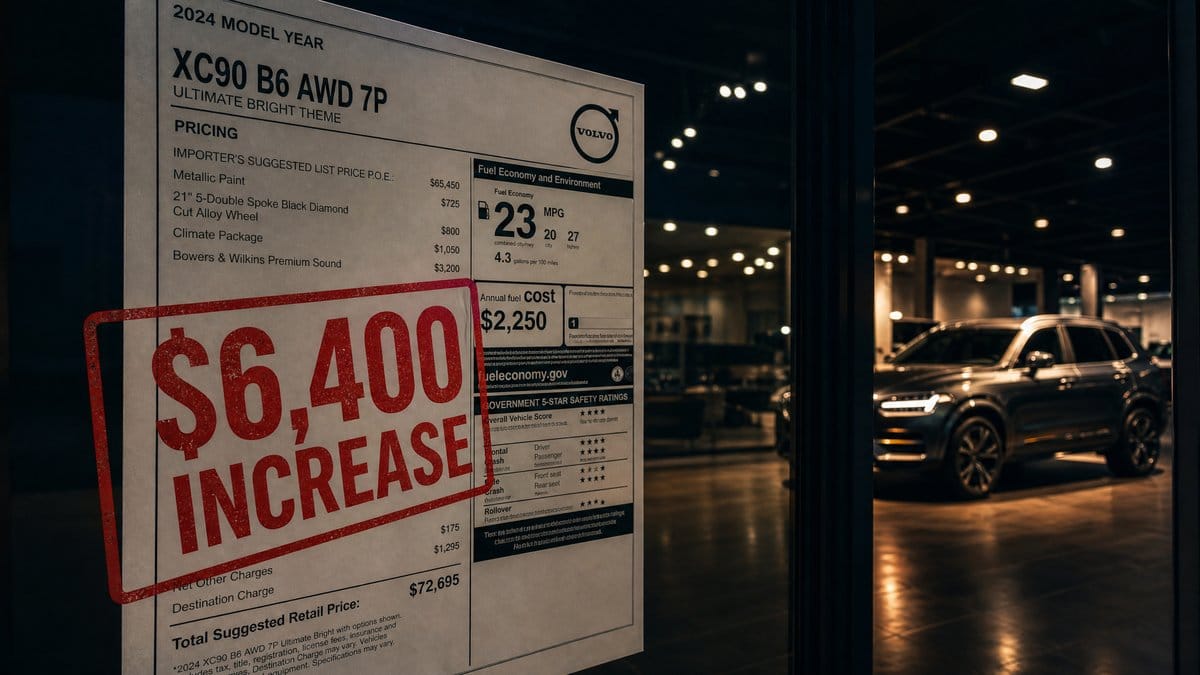

The reality is, the $10.6 billion in auto tariffs paid by US automakers isn't just a headline—it's a direct tax on every deal that crosses your desk. When new vehicle prices spike 10-20% because of tariffs on parts from Canada and Mexico, customer budgets don't magically expand to absorb the hit. Instead, that cost compresses their buying power, forces them into longer terms, or pushes them entirely out of the new car market and into used vehicles. If your F&I process hasn't adapted to this structural shift in affordability, you are leaving money on the table and exposing your customers to catastrophic risk.
Here's the deal: We are operating in an environment where the average monthly payment has hit a record high of $777, and the average amount financed is sitting at $43,925. Add a 10-20% tariff-driven price increase on top of that, and you have a recipe for severe budget compression. Customers are stretching further than ever just to get into the vehicle, which means their tolerance for unexpected repair costs is exactly zero. This isn't a temporary blip; it's the new architecture of the deal. The question isn't whether the tariffs are impacting your customers—it's whether your F&I presentation is built to protect them when they are financially maxed out.
Look, the amateur F&I manager sees a $777 payment and assumes the customer is tapped out. They pre-judge the deal, skip the presentation, and hope to just get the paperwork signed. That is a fundamental failure in execution discipline. The elite Tier-1 operator understands that when a customer is stretched to their absolute limit, the need for a Vehicle Service Contract (VSC) and GAP coverage doesn't decrease—it becomes critical. If they can barely afford the $777 payment, how are they going to afford a $3,500 transmission repair? They can't. The tariff tax creates urgency for protection, but only if you have the architecture in place to present it correctly.
The Direct Impact of the $10.6 Billion Tariff Tax on F&I
Let's look at the math. US automakers have absorbed roughly $10.6 billion in tariffs on parts imported from Canada and Mexico. That cost doesn't vanish; it gets passed down to the consumer, resulting in new vehicle prices jumping 10-20%. When a $40,000 vehicle suddenly costs $44,000 to $48,000, the customer's base payment anchor shifts dramatically before they even step into your office. This isn't semantic. It's structural. The entire financial foundation of the deal has been altered by macroeconomic forces outside of your control, but how you respond to those forces is entirely within your control.
What happens when the base payment is already stretching the customer's budget? The reality is, the customer is walking into the F&I office already defensive. They know they are paying more than they wanted to. They know the interest rates are high. They know the vehicle price is inflated. If your approach is to simply add more cost to an already inflated payment without establishing undeniable value, you will fail. You will get the affordability objection, and you will lose.
This is where the Menu Order System becomes your most valuable asset. The Menu Order System controls the sequence of the presentation. It ensures that you are not just throwing numbers at a defensive customer, but rather logically walking them through their financial exposure. When the base payment is high due to tariffs, the Menu Order System allows you to isolate the cost of the vehicle from the cost of the protection. It forces the customer to acknowledge the risk they are taking on by driving an unprotected vehicle that they are already struggling to afford.
Here's the thing: The tariff tax is a reality. You cannot change it. But you can change how you present the solution. If a customer is financing $43,925, they are making a massive financial commitment. Your job is not to apologize for the price; your job is to protect the investment. When you shift your mindset from "selling products" to "installing protections," the conversation changes. You are no longer a salesperson trying to extract more money; you are a financial professional helping them mitigate risk.
The Shift to the Used Car Market: Where VSC Matters More
Because of the tariff-driven price hikes on new vehicles, we are seeing a massive migration of buyers into the used car market. But here's the thing: used car prices aren't immune. They've been dragged up by the demand, rising $1,300 to $3,600 in the first half of 2026 alone, with values jumping another 4.8% in June. The affordability crisis isn't just a new car problem; it's an industry-wide reality.
When a customer is forced into a used vehicle because they've been priced out of new, they are taking on significantly more mechanical risk. The factory warranty is either depleted or entirely gone. This is where your upgrade architecture must be flawless. You are no longer just selling convenience; you are selling financial survival. If a customer is stretching to buy a used car at a premium price, a major mechanical failure isn't just an inconvenience—it's a financial catastrophe.
Consider the data: 45% of vehicle owners are dissatisfied with service due to unexpected costs. When a customer buys a used vehicle at a premium price, their expectation is that it will run perfectly. When it doesn't, and they don't have coverage, they blame the dealership. They don't blame the tariffs. They don't blame the market. They blame you. Your job in F&I is to install a process that makes the risk of driving unprotected painfully clear, without using pressure tactics. It's about logical sequence and structural consistency.
The upgrade architecture is the standardized method for moving customers up from a base level of protection to comprehensive coverage. In the used car market, this is critical. You cannot assume that because they bought a used car, they only want basic powertrain coverage. The reality is, the electronics, the sensors, the infotainment systems—these are the components that fail and cost thousands to repair. Your upgrade architecture must logically demonstrate why comprehensive coverage is the only responsible choice for a customer who is already financially stretched.
This is what works: You use the client survey to identify how long they plan to keep the vehicle and how many miles they drive. You use that data to build a customized presentation that highlights their specific exposure. "Mr. Customer, you mentioned you plan to keep this vehicle for five years and drive 15,000 miles a year. Based on the current mileage, that means you will be driving this vehicle well past the 100,000-mile mark. The reality is, the likelihood of a major component failure during that time is extremely high. This is why we must put this protection in place." Direct. Factual. Undeniable.
Negative Equity: The Silent Killer Amplified by Tariffs
The tariff tax doesn't just affect the purchase price; it exacerbates the negative equity epidemic. Right now, 31% of trade-ins are underwater, with an average negative equity of $7,200. Even more alarming, 25% are carrying $10,000 or more in negative equity, and 12% are carrying $15,000 or more. This is a staggering amount of unsecured debt being rolled into new loans.
When you combine a 10-20% price increase on the new vehicle with $7,200 in negative equity, the loan-to-value (LTV) ratio explodes. This is where GAP coverage transitions from a "nice-to-have" to an absolute necessity. If that vehicle is totaled, the customer isn't just out a car; they are financially ruined. They will owe thousands of dollars on a vehicle that no longer exists, while simultaneously needing to purchase a replacement vehicle in an inflated market.
This is NOT the time for a weak presentation. This IS the time for a GAP conversation that works. You must use the client survey to identify the risk, and then use the numbers as statements to anchor the reality of their situation. "Mr. Customer, you are financing $51,000 on a vehicle valued at $40,000. In the event of a total loss, your insurance will only cover the $40,000. The $11,000 difference is your responsibility. This is why we must put this protection in place."
The biggest thing is that you cannot shy away from the negative equity conversation. Too many F&I managers try to gloss over it, hoping the customer won't notice how much they are rolling over. That is a mistake. You must confront the negative equity head-on. You must use it as the foundation for your GAP presentation. The negative equity is the problem; GAP is the solution. If you present it logically and factually, the customer will understand that they cannot afford to decline the coverage.
Furthermore, the rise in subprime 60-day delinquency—hitting 5.49% in May 2026, the third highest since 1994—indicates that consumers are struggling to keep up with these inflated payments. When a customer is already on the edge of delinquency, a total loss without GAP coverage will push them over the edge into default. Your responsibility as an elite F&I manager is to protect the lender, protect the dealership, and protect the customer by ensuring that GAP is installed on every deal with significant negative equity.
The Affordability Illusion: Why "Tapped Out" is a Myth
One of the biggest lies F&I managers tell themselves is that the customer is "tapped out" because of the high price of the vehicle. This is an excuse for poor performance. The reality is, customers find money for what they value. If they understand that a VSC is the only thing standing between them and a catastrophic repair bill they can't afford, they will find the $40 a month to protect themselves.
The problem isn't the customer's budget; it's your objection prevention framework. If you are getting affordability objections at the end of your presentation, it means you failed to build value at the beginning. You didn't use the pre-deal scan effectively. You didn't ask the right questions during the client survey. You didn't establish the base payment anchor correctly.
When a customer says, "I can't afford it," what they are really saying is, "You haven't convinced me that the risk of not having this is greater than the cost of buying it." In a market where tariffs have inflated prices and compressed budgets, your precision in communicating that risk must be absolute. You cannot rely on generic pitches or emotional appeals. You must use data, logic, and structural consistency.
The objection prevention framework is proactive, not reactive. It starts the moment you greet the customer. It involves setting expectations, gathering information through the client survey, and using that information to tailor your presentation. If you know the customer is stretching their budget, you don't ignore it—you address it. "Mr. Customer, I see that this payment is at the top of your budget. That tells me that protecting this investment is critical, because an unexpected repair bill would be devastating. Let's look at how we can structure this to ensure you are protected."
This approach disarms the customer. It shows that you are on their side, that you understand their financial situation, and that you are offering a solution, not just trying to sell them something. It shifts the dynamic from adversarial to collaborative. And when you do that, the "tapped out" myth disappears, replaced by a logical discussion about risk management.
Adapting Your F&I Process to the Tariff Reality
So, how do you adapt? You don't need a new personality; you need a better system. Systems produce results, not individuals. Here is the architecture you must install to thrive in this high-tariff, high-cost environment:
| The Old Way (Failing) | The ASURA Way (Elite) |
|---|---|
| Pre-judging the deal based on the $777 average payment. | Executing a 60-second pre-deal scan to understand the exact numbers and risk profile. |
| Assuming the customer can't afford protections because of the 10-20% tariff price hike. | Using the price hike to create urgency for VSC and GAP, knowing they can't afford a repair. |
| Reacting to affordability objections at the end of the menu. | Using the Objection Prevention Framework to eliminate the affordability concern before it's voiced. |
| Selling "products" based on features. | Installing "protections" based on the customer's specific financial exposure. |
| Inconsistent presentations based on how the manager "feels" about the deal. | 100% Menu presentation rate, every customer, every time, with structural consistency. |
This isn't semantic. It's structural. If you want to maintain or grow your PVR in a market where dealer profits are already down 16% in the first half of the year, you must have the discipline to run the play exactly as designed, every single time. You cannot allow the macroeconomic environment to dictate your performance. You must control the controllable, and the only thing you can control is your process.
The pre-deal scan is your first line of defense. It is NOT a 5-10 minute deep analysis. It's a QUICK SCAN. All you need are the numbers they agreed to (repayment matrix / buyer's order) and the client survey. You do NOT need vehicle specs, lender details, credit profile breakdowns, or product fit notes. Grab the numbers, go get the customer, process them. Handle the rest from inside the box. This speed and efficiency prevent the customer from sitting in the showroom stewing over the price, which only increases their resistance when they finally get to your office.
Once they are in your office, the execution discipline must be flawless. The base payment anchor must be stated as a statement, not a question. The menu presentation must follow the exact sequence designed to build value and isolate risk. The upgrade architecture must be used to logically move the customer to the appropriate level of coverage. Every step must be executed with precision.
The Role of the Coaching Cadence in Maintaining Discipline
You can read this article, agree with everything in it, and still fail to execute. Why? Because knowing what to do and actually doing it under pressure are two different things. When the showroom is busy, the desk is screaming for the deal, and the customer is hostile about the price, variance creeps in. You start skipping steps. You drop the client survey. You rush the menu. You revert to old habits.
This is why a 15-minute weekly coaching cadence is non-negotiable. It is the consistency lock that prevents drift. It's not about training; it's about installation. Training is an event; installation is a continuous process of refinement and accountability. You don't train a professional athlete once and expect them to perform at an elite level forever. You coach them constantly. The same applies to F&I.
If you are a dealer principal or a GM, you cannot expect your F&I team to navigate the complexities of a tariff-impacted market without consistent, structured coaching. The $10.6 billion tariff tax is a structural challenge that requires a structural solution. Your people aren't failing because they're lazy. They're failing because they lack the architecture to succeed in this specific environment. They need a system, and they need the coaching cadence to ensure that system is executed with discipline.
The coaching cadence is where you review the tape. It's where you look at the deals that were missed and identify the point of failure. Did they skip the client survey? Did they fail to establish the base payment anchor? Did they crumble at the first affordability objection? By identifying the specific breakdown in the process, you can correct it before it becomes a habit. This is how you build an elite F&I department. This is how you achieve structural consistency.
The Regulatory Environment: Why Process is Your Only Protection
While we are discussing the impact of tariffs and affordability, we cannot ignore the regulatory environment. In March 2026, the FTC sent warning letters to 97 dealer groups regarding their F&I processes. State AG penalties have been severe: $3.1M in Maryland, $3.2M in NY, $20M in Illinois, and $1.5M in CT. The regulators are watching, and they are looking for variance.
When your F&I managers are improvising their presentations because they are intimidated by the high prices and compressed budgets, they are creating variance. Variance is not just the enemy of performance; it is the enemy of compliance. If one customer gets a full menu presentation and another gets a rushed, high-pressure pitch because the manager assumed they were "tapped out," you have a compliance problem.
The only way to protect the dealership from regulatory scrutiny is to install a process that is executed exactly the same way, every single time, regardless of the customer's budget, the vehicle price, or the manager's mood. The Menu Order System and the Objection Prevention Framework are not just sales tools; they are compliance tools. They ensure that every customer is treated fairly, that all protections are presented transparently, and that the dealership is protected from liability.
This is another reason why the coaching cadence is so critical. It is your opportunity to audit the process and ensure that compliance standards are being met. If you find that a manager is skipping steps or using unapproved language, you can correct it immediately. You cannot afford to wait for an FTC warning letter to realize that your F&I process is broken.
The Future of F&I in a High-Cost Market
The reality is, the market has changed. The tariffs are here, the prices are up, and the budgets are tight. But the need for protection has never been higher. The extended warranty market is currently valued at $23.6 billion and is growing at a 6.9% CAGR. Consumers want protection. They know that vehicles are becoming more complex and more expensive to repair. The demand is there.
The challenge is not the demand; the challenge is the presentation. If you continue to rely on outdated, feature-based selling techniques, you will struggle. If you allow the high prices and compressed budgets to dictate your performance, you will fail. But if you install the right architecture—the Menu Order System, the Upgrade Architecture, the Objection Prevention Framework, and the Coaching Cadence—you will thrive.
You must embrace the reality of the market and use it to your advantage. The $10.6 billion tariff tax is not an excuse for poor performance; it is an opportunity to demonstrate the undeniable value of the protections you offer. When a customer is stretched to their absolute limit, they need you more than ever. They need you to protect them from the catastrophic financial consequences of an unexpected repair or a total loss.
This is what it means to be an elite Tier-1 operator. It means executing the process with precision and discipline, regardless of the macroeconomic environment. It means taking control of the deal and guiding the customer to the logical conclusion that they cannot afford to drive unprotected. It means building an identity based on excellence and accountability.
Key Takeaways
- The $10.6 billion in auto tariffs has driven new vehicle prices up 10-20%, severely compressing customer budgets and altering the financial foundation of every deal.
- This budget compression makes Vehicle Service Contracts (VSC) and GAP coverage more critical, not less, as customers cannot absorb unexpected repair costs when they are already stretched thin.
- The tariff tax is pushing more buyers into the used car market, where prices are also rising and mechanical risk is higher, increasing the need for flawless upgrade architecture.
- With 31% of trade-ins underwater (averaging $7,200 in negative equity), GAP coverage is an absolute necessity to protect customers from financial ruin in the event of a total loss.
- Affordability objections are a symptom of a failed objection prevention framework; elite operators use the client survey and base payment anchor to build undeniable value early in the process.
- Surviving and thriving in this market requires structural consistency, execution discipline, and a strict adherence to the Menu Order System to eliminate variance.
- A weekly coaching cadence is the only way to prevent variance, ensure compliance, and guarantee the process is executed perfectly under pressure.
FAQ: Navigating Auto Tariffs and F&I Affordability
How do the $10.6 billion in auto tariffs directly impact F&I performance?
The tariffs have caused new vehicle prices to rise by 10-20%, which compresses the customer's available budget. This makes it harder to sell protections if the F&I manager relies on traditional, feature-based selling. However, it also creates a massive opportunity, as customers who are stretched financially are in greater need of VSC and GAP to protect against catastrophic out-of-pocket expenses.
Why are customers moving to the used car market, and how does that affect F&I?
Customers are being priced out of the new car market due to tariff-driven price increases. As they move to used vehicles, they take on more mechanical risk because factory warranties are often expired. This makes the presentation of a Vehicle Service Contract (VSC) critical, requiring a precise upgrade architecture to communicate the risk effectively.
How should F&I managers handle the "I can't afford it" objection in a high-price market?
The key is objection prevention, not objection handling. By using a thorough client survey and establishing a firm base payment anchor early in the process, the F&I manager builds the value of the protections before the menu is even presented. If the customer understands that they cannot afford a $3,500 repair bill, they will find the budget for the monthly protection cost.
What role does negative equity play in the current F&I landscape?
Negative equity is at epidemic levels, with 31% of trade-ins underwater by an average of $7,200. When combined with higher vehicle prices, this creates dangerous loan-to-value ratios. F&I managers must use this data to logically demonstrate the absolute necessity of GAP coverage to protect the customer from financial ruin.
Why is a weekly coaching cadence necessary for F&I success?
In a challenging market with high prices and compressed budgets, variance is the enemy of performance. A 15-minute weekly coaching cadence acts as a consistency lock, preventing F&I managers from drifting away from the established process and ensuring execution discipline on every deal.
How does the pre-deal scan differ from traditional deal analysis?
The pre-deal scan is a rapid, 60-second review focused solely on the agreed-upon numbers (repayment matrix/buyer's order) and the client survey. It avoids getting bogged down in unnecessary details like vehicle specs or lender profiles, allowing the F&I manager to quickly process the customer and handle the deal from inside the established framework.
How does the regulatory environment impact the need for a structured F&I process?
With increased scrutiny from the FTC and state AGs, variance in the F&I presentation is a major compliance risk. A structured process like the Menu Order System ensures that every customer receives a consistent, transparent presentation, protecting the dealership from regulatory penalties and liability.
The reality is, the market has changed. The tariffs are here, the prices are up, and the budgets are tight. But the need for protection has never been higher. It's time to stop making excuses and start executing the process. If you want to build an elite F&I department that thrives regardless of market conditions, you need the right architecture.
Install the ASURA Coaching Cadence today and turn market challenges into PVR growth.