
Stellantis U.S. sales dropped roughly 15% in Q1 2025 on top of a brutal 2024. Jeep Grand Cherokee inventory sat at over 200 days on some lots. Ram 1500 pricing got so out of touch that dealers were sitting on $70,000 trucks nobody could finance. And if you're an F&I manager working a Chrysler, Dodge, Jeep, or Ram store right now, you already know what the spreadsheets say — your PVR has been under pressure, your penetration numbers are getting squeezed by lender pushback, and your paycheck is smaller than it was 18 months ago.
This is the Stellantis dealer crisis. And it's not a temporary blip. It's a full-blown structural problem — brand confusion, product cadence issues, dealer network friction, and now the FTC CARS Rule enforcement kicking in June 16, 2026. If you're an F&I professional at a struggling Stellantis franchise, you don't have the luxury of waiting for corporate to figure it out. Your income, your career, and your reputation are all on the line right now.
Let's talk about what actually happened, why it matters to your paycheck, and — most importantly — what you're going to do about it starting Monday morning.
How Stellantis Ended Up in Freefall
You have to understand what happened to know how to protect yourself. Stellantis wasn't always a mess. Back in 2021 and 2022, Jeep and Ram were minting money. Wagoneer launches, Ram 1500 dominance, Jeep loyalty at all-time highs. Then leadership decided margins mattered more than volume. They cranked MSRPs. They cut incentives. They ignored dealer feedback about pricing walls. And they doubled down on hybrid strategies — the eTorque nobody wanted, the plug-in hybrids that confused shoppers, the pause-and-restart approach to EVs.
By early 2024, dealer inventory was ballooning. Days supply on some models crossed 180. Jeep Compass and Cherokee — gone or in transition. Ram 1500 Classic — the affordability play — discontinued. Grand Cherokee — dealers stuck with loaded trims at $65k+ when the customer wanted $48k. The Dodge Charger relaunched as an EV with a gas variant that isn't shipping in real volume. And Chrysler? The brand is essentially two minivans and a prayer.
Then the CEO change happened. Carlos Tavares out. New leadership in. Interim strategies. Dealer council lawsuits. National Automobile Dealers Association public letters. The whole ecosystem cracked open. And through it all, the F&I office was expected to hit numbers on deals that were $8,000 upside down before you even walked in the room.
I worked with a Jeep-Ram store in Ohio last spring. Their PVR had dropped from $2,100 to $1,340 in nine months. Not because their process got worse. Because their deals got worse. Higher payments, deeper negative equity, tighter lender advances, customers stretched to 84 months just to make the math work. The F&I manager was doing everything right. The deals were the problem.
That's the environment you might be operating in. And it's not going to fix itself in Q1 2026. Which means you have to fix your side of the equation — the part you actually control.
What the Stellantis Crisis Actually Does to Your Paycheck
Let's get specific about how a struggling franchise hurts your income, because you can't fight a problem you haven't diagnosed.
First, PVR compression. When deals are structured tight — high LTV, high payment, thin front — you have less room in the box. Lenders cut back-end reserves. VSC pricing gets challenged harder because the customer is already at their ceiling. GAP becomes a survival product instead of a profit product. Your average product count drops from 2.4 to 1.9. On a store doing 80 units, that's roughly $9,600 a month in lost gross — and a chunk of that is coming directly out of your commission.
Second, penetration erosion. When 40% of your customers are stretched to 84 months at 9.5% APR with $12,000 in negative equity rolled in, VSC penetration becomes brutal. The payment shock on a $2,800 VSC over 84 months is real. Customers say no. Not because you presented poorly — because they physically cannot absorb another $35 a month. This is the negative equity epidemic playing out in real time, and Stellantis stores are getting hit worse than most because of the pricing wall.
Third, lender friction. Stellantis Financial Services (formerly Chrysler Capital via Santander partnership) has been aggressive at times and tight at others. Advances shift. Backend caps move. Warranty flats change. If you're not building relationships across five or six alternate lenders, you're at the mercy of one book that's tuned for their portfolio, not your customer.
Fourth, and this is the one nobody talks about — mental fatigue. When you're grinding on tough deals every day, when the sales floor is bringing you customers who are already frustrated, when you're the last person standing between a lost deal and a delivered car, you burn out. Your presentations get flat. Your energy drops. You start conceding products before the customer even objects. That's when the death spiral starts.
The FTC CARS Rule and Why June 16, 2026 Changes Everything
Now overlay compliance on top of a struggling franchise. The FTC CARS Rule enforcement date is June 16, 2026. If you don't have your process buttoned up before then, you're not just losing money — you're creating regulatory exposure that could end careers and shut stores.
The CARS Rule requires clear disclosure of add-on prices, express informed consent for every product, and prohibits any misrepresentation about whether add-ons are required. Sounds simple. It's not. Because it demands that your menu presentation be crystal clean, that your customer signs specifically for each product, and that you have documentation showing they understood the cost, the terms, and the optional nature of everything on the deal.
If your store is already stressed — margin compression, dealer principal breathing down your neck, sales managers packing payments to make deals work — the temptation to cut corners on disclosure grows. That's a career-ending trap. The FTC has already warned 97 dealer groups about F&I process failures. When enforcement teeth come in June 2026, they're not going to grade on a curve for struggling franchises.
Here's the reality — a compliant process is also a more profitable process. When your menu is clean, your disclosures are tight, and your customer says yes with full understanding, your cancellation rate drops. Your chargeback exposure drops. Your CSI improves. Your menu order and PVR both go up because you're not fighting objections on the back end. Compliance and profit aren't at odds. Sloppy is the enemy of both.
If you're at a Stellantis store, use the next six months to over-invest in process discipline. Because when the audit comes — and it will come — you want to be the person the dealer principal points to and says "she runs it clean."
Building an F&I Process That Works Even When the Franchise Doesn't
Here's the truth nobody wants to hear — a great F&I process produces at almost any store. I've seen $2,600 PVR out of struggling franchises. I've seen $900 PVR at top-performing brands. The variable isn't the marquee on the building. It's the discipline in the box.
Start with your pre-deal scan. Sixty seconds before the customer sits down, you should know their credit tier, LTV, payment-to-income ratio, negative equity position, and what lenders will realistically hit that deal. If you're walking into a delivery blind, you're already losing $400 in PVR. Get the pre-deal scan process installed and non-negotiable.
Next, own the transition. Fifteen seconds from sales to F&I is the standard. Not five minutes. Not "let me finish this paperwork." Fifteen seconds of intentional handoff where the salesperson transfers trust, sets the F&I expectation, and puts the customer in your hands warm. If your sales team hasn't been trained on the 15-second transition, that's your Monday morning meeting.
Then build your menu around base payment anchoring. Show the base payment first — that's the payment with zero products, worst-case-scenario finance terms. Then walk up the menu columns from there. This is the base payment anchor technique, and it protects you against the two biggest killers in a distressed franchise: payment shock objections and "I need to think about it" fadeouts.
Your VSC presentation has to evolve for the Stellantis reality. These are complex vehicles. Uconnect systems, electronic transfer cases, air suspensions, hybrid components. Repair costs are climbing 8-11% annually. A $6,000 electronic module isn't unusual on a Grand Cherokee. Your VSC conversation shouldn't be about "peace of mind" — it should be about specific dollar amounts on specific components with specific repair frequencies. Give the customer numbers they can't argue with.
And your GAP conversation? In a market where 27% of trade-ins have negative equity averaging over $6,800, GAP isn't optional in your presentation. It's mandatory. Not mandatory to buy — mandatory to present with full clarity. Learn the GAP conversation that actually works and run it every deal, every time.
Protecting Your Income When the Store Is Struggling
Let's talk about you personally. Because F&I professionals at Stellantis stores are asking me the same question over and over — should I stay or should I go?
My answer: it depends on three things. Is your dealer principal reinvesting in the store or coasting? Is your management team competent or dysfunctional? Is your personal brand strong enough to move if you need to?
If your dealer principal is reinvesting — CRM upgrades, F&I training, facility improvements, expanding to new franchises — stay. Struggling franchises with strong ownership eventually recover, and you'll be the veteran who rode out the storm. If your dealer principal is coasting or dumping cash, start your search now. Not out of panic — out of strategy.
Regardless of which category you're in, you should be building your personal book. Track your own numbers. PVR by month, by product, by lender. Product penetration rates. Chargeback percentages. CSI scores. Customer testimonials. If you can walk into any GM's office with a clean one-page performance summary showing 24 months of consistent production, you've got leverage anywhere in the country.
Learn to speak the language of the 5 KPIs that predict F&I performance. Because when you interview, the smart dealer principals aren't asking about your best month. They're asking about your worst month. They want to see the floor of your production, not the ceiling. Know your floor. Own your floor. Improve your floor.
Also, understand your pay plan. If you're at a Stellantis store where deals are getting harder, is your pay plan structured to protect you or exploit you? A commission-only plan that was fine at $2,200 PVR becomes brutal at $1,400 PVR. Read the piece on F&I pay plan structure and have an honest conversation with your GM. If they won't restructure, that tells you what you need to know.
And build your lender relationships independently. When you leave one store and go to another, the strongest currency you carry is your lender relationships. Buyers you can call directly. Reps who take your escalations. That's professional capital that follows you anywhere.
The Turnaround Play — How to Be Part of the Solution
If you decide to stay and fight, don't just defend your desk. Go make yourself indispensable to the entire operation. Struggling franchises are opportunities for people who can lead through difficulty.
Volunteer to run the compliance readiness project for the CARS Rule. Every Stellantis store in America needs someone who's obsessed with getting the process CARS-Rule-ready before June 2026. If that person is you, you're the most valuable employee in the building — and your dealer principal knows it.
Build the F&I bench. Even at a struggling store, turnover happens. If you can develop a floor rep into a producer, if you can create a system to build the F&I bench from zero, you become the person who fixes the future. That's a promotion story, whether at your current store or the next one.
Install a coaching cadence for yourself and your team. Fifteen minutes a week is enough. Deal reviews, objection handling drills, word tracks refined against actual customer pushback. The 15-minute weekly coaching cadence is the single most underused tool in the F&I world. Struggling stores especially need it because reps get demoralized fast, and structured coaching is how you rebuild confidence one deal at a time.
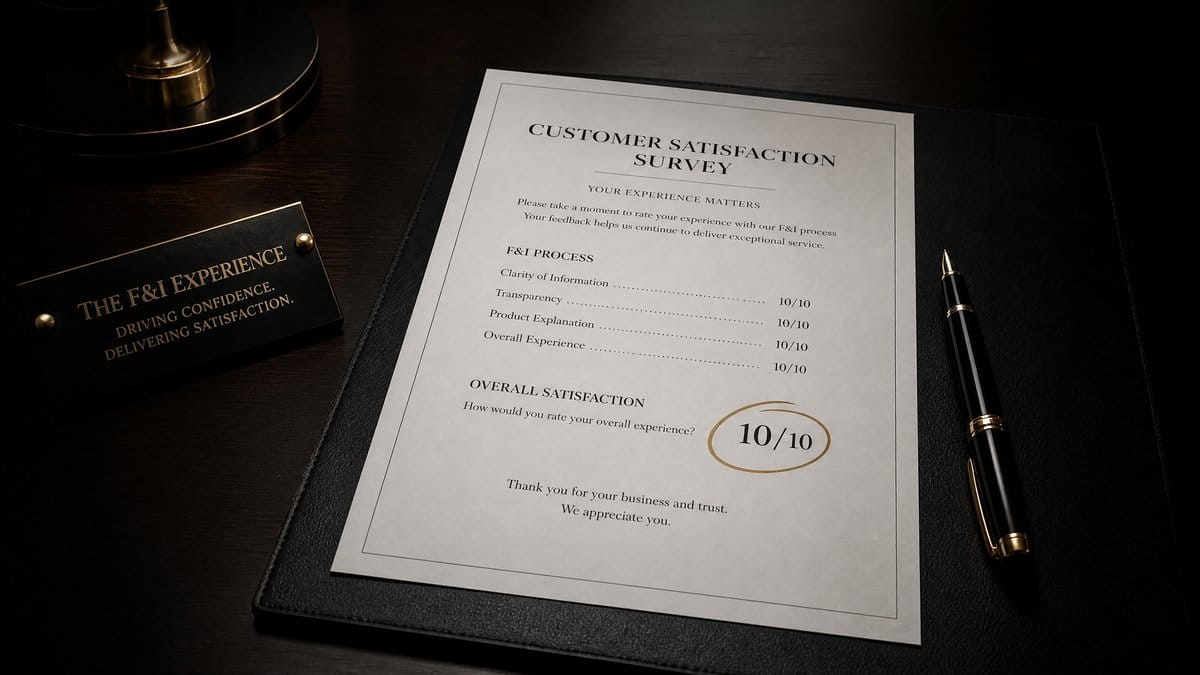
Get obsessive about the survey. In a market where consumer trust in Stellantis products is shaky, customer surveys are the tiebreaker. Every 5-star survey with an F&I mention builds your brand at the store and personally. Learn the client survey strategy and make it part of your close every deal.
And build the audit habit. Every 90 days, do a full F&I process audit on yourself. What's slipping? What's tightening? Where's the money hiding? Struggling stores hide profit — not because anyone's stealing, but because the noise of daily crisis makes people miss the details. Be the F&I manager who never misses the details.
The Long Game — Where Stellantis Goes From Here and What It Means for You
Nobody knows for certain how Stellantis rebuilds. The new leadership team is signaling smaller displacement engines, more affordable trims, faster product cadence, and a rebuilt dealer relationship. Ram 1500 pricing is coming down. Jeep is talking about a sub-$25k Renegade replacement. Chrysler will get a real product refresh. But even if all of that lands perfectly, you're 18-24 months from meaningful improvement at store level.
Meanwhile, the industry around you is shifting fast. Lease returns are coming back — over 500,000 vehicles hitting the used market in what people are calling the lease return tsunami. That's opportunity for Stellantis stores because used inventory becomes affordable inventory. If you build a strong used F&I process, you can offset new car margin compression significantly.
Tariffs are reshaping affordability. Every deal has a tariff tax baked in, and Stellantis vehicles — many built in Canada and Mexico — carry more of that burden than domestic-built competitors. Your job is to translate that reality into a customer conversation about protection, retention, and long-term ownership costs.
AI is entering the F&I process. Deal grading, transaction analysis, coaching feedback loops — AI grading of F&I transactions is going to be standard within 24 months. The F&I managers who embrace it early become the coaches of tomorrow. The ones who resist it become the case studies of what not to do.
Here's the mindset shift I want you to make. A struggling franchise isn't a career sentence — it's a laboratory. The skills you build fixing broken deals at a Stellantis store in 2025 are the skills that make you unstoppable at any store in 2027. Distress creates discipline. Discipline creates production. Production creates options.
The F&I managers who thrived through the 2008-2010 recession, through the 2020 pandemic, through the 2022 chip crisis — they all shared one trait. They didn't wait for conditions to improve. They improved their process while the world burned. That's the play.
Frequently Asked Questions
How much has the Stellantis dealer crisis affected F&I PVR at Chrysler, Dodge, Jeep, and Ram stores?
Based on data across dozens of Stellantis stores in 2024-2025, F&I PVR has compressed 15-30% versus 2022 highs at most locations. The drop isn't caused by process breakdown — it's caused by deal structure. Higher MSRPs, more negative equity, tighter lender advances, and longer term financing all reduce the room for backend product. Stores that adapted their menu strategy, tightened compliance, deepened lender relationships, and coached their teams weekly have held PVR in the $1,800-$2,200 range. Stores that stayed static have dropped below $1,400. The variable isn't the brand — it's the discipline. Struggling franchises reward disciplined operators disproportionately because most competitors give up.
What does the FTC CARS Rule enforcement on June 16, 2026 mean for Stellantis F&I managers?
The CARS Rule requires clear disclosure of every add-on price, express informed consent for each product, and elimination of any language suggesting products are required for financing. For F&I managers at struggling Stellantis stores, the pressure is doubled — you're under margin stress AND regulatory scrutiny simultaneously. The right response is process tightening, not corner cutting. Every deal needs a clean menu, individual product acknowledgment, documented disclosures, and a paper trail that survives audit. Stores that invest the next six months in CARS Rule readiness will be the survivors. Stores that hope enforcement is soft will find out it isn't. Career-ending violations are enforced by the FTC, state AGs, and consumer plaintiffs' attorneys.
Should I leave my Stellantis dealership job because of the brand's problems?
Not automatically. Three questions decide it. First, is your dealer principal reinvesting in the store or coasting? Reinvestment means they believe in the recovery. Coasting means they're preparing to exit. Second, is your management team competent? A great GM can produce results in any market. A poor one can't win even at a top brand. Third, is your personal production strong enough to move? If your last 24 months show consistent PVR and product penetration, you have options anywhere. If you're staying because you're afraid to interview, that's the wrong reason. Stay because there's opportunity to lead through the turnaround — not because you're trapped.
How do I present GAP and VSC when Stellantis customers are already stretched on payment?
You anchor to the base payment first — the worst-case scenario payment with zero products. Then you walk them up the menu with specific dollar amounts tied to specific risks. For VSC on Stellantis products, use real repair costs — Uconnect module replacement runs $2,800-$4,200, electronic transfer cases on 4WD models exceed $5,000, air suspension components on Grand Cherokee and Wagoneer regularly break the $6,000 mark. For GAP, use the negative equity data — the average Stellantis customer in 2025 is rolling $7,400 in negative equity into their new loan. That's the exposure GAP eliminates. Numbers close deals. Emotion doesn't work on stretched customers.
What's the fastest way to protect my F&I income at a struggling Stellantis franchise?
Three moves this week. First, install a 60-second pre-deal scan on every deal so you walk into every delivery knowing credit tier, LTV, and lender options before the customer sits down. Second, tighten your menu to base-payment-anchor format so payment shock stops killing your backend. Third, start a 15-minute weekly coaching session — even with yourself — reviewing your best and worst deal of the week and refining one specific word track. These three habits alone typically add $200-$400 to PVR within 60 days regardless of franchise health. Then layer in compliance readiness, lender relationship building, and personal brand development for long-term protection.