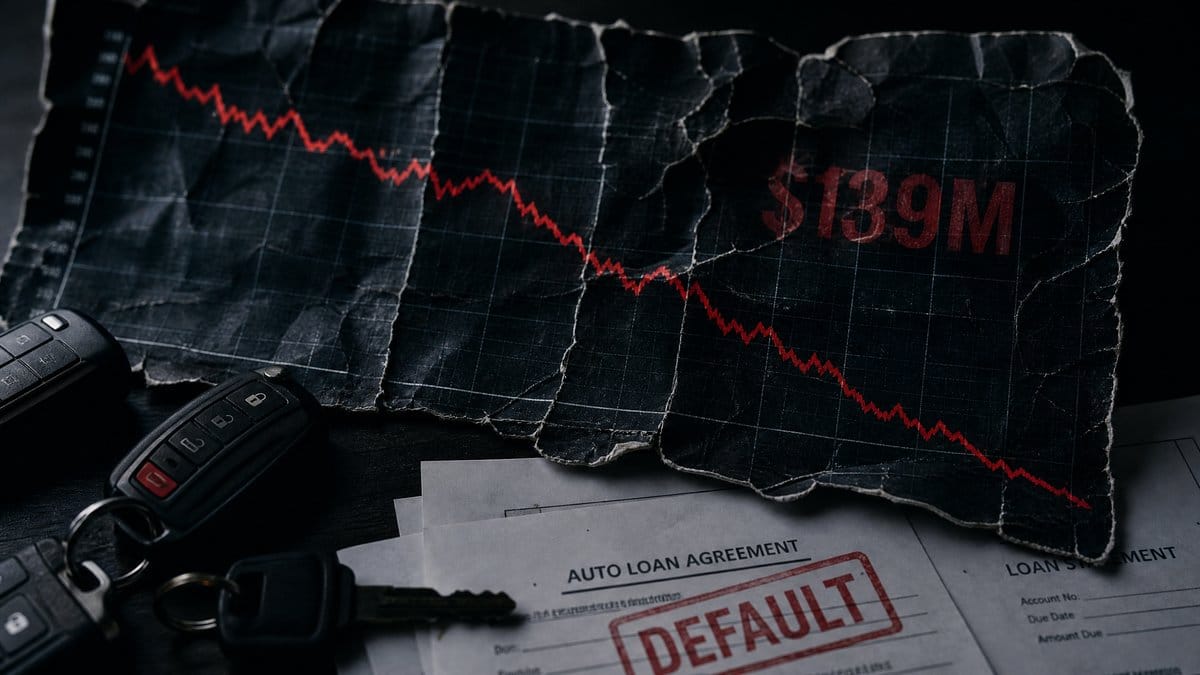

Subprime delinquency just hit a 32-year high, and if you are not adjusting your deal structure and product presentation right now, you are going to lose approvals and leave massive PVR on the table. In January 2026, subprime 60-day past due (DPD) rates spiked to 6.9%—the highest we have seen since the 1990s—and settled at a still-dangerous 5.49% in May. This isn't just a macroeconomic headline; it is a direct threat to your lender relationships, your funding speed, and your ability to protect high-risk borrowers who desperately need VSC and GAP coverage.
Here's the deal: When delinquency rates climb, lenders tighten their belts. They look closer at loan-to-value (LTV) ratios, they scrutinize payment-to-income (PTI) metrics, and they start kicking deals back that would have been auto-approved six months ago. The reality is, you cannot run a subprime deal through the exact same Menu Order System and upgrade architecture as an 800-beacon prime buyer. You need a specific, structural approach to deal structuring and product presentation that satisfies the lender's risk models while still installing the protections the customer needs.
This is what works. We are going to break down exactly how this 32-year high in subprime delinquency affects your F&I desk, how to structure deals to get them bought, and why your presentation of Vehicle Service Contracts (VSC) and Guaranteed Asset Protection (GAP) must shift from a "nice-to-have" to an absolute necessity for high-risk borrowers.
The Reality of the 2026 Subprime Delinquency Spike
Let's look at the numbers, because the numbers dictate the process. In January 2026, subprime 60-day delinquency hit 6.9%. That is the highest level since the 1990s. By May, it was at 5.49%, which is still the third-highest rate since 1994. What happens when delinquency hits these levels? Lenders panic. They adjust their algorithms. They start looking for reasons to say no.
This is NOT a temporary blip. This IS a structural shift in the subprime market driven by inflation, rising living costs, and the fact that the average monthly payment has hit a record high of $777. When a subprime borrower is stretched that thin, any unexpected expense—like a $2,500 transmission repair—means they default on the car loan. Lenders know this. That is why they are terrified of naked deals (deals without a VSC) in the subprime tier.
The biggest thing is understanding that lenders are not just looking at the credit score anymore; they are looking at the structural integrity of the deal. They want to see that the customer can afford the payment, but they also want to see that the asset is protected. If the car breaks down and the customer cannot afford to fix it, they stop paying. It is that simple. This is why your lender relationship playbook must evolve.
We are seeing the fallout across the industry. Dealer profits are down 16% in the first half of 2026, and a massive part of that is the inability to get marginal deals funded. When you have 31% of trade-ins underwater, carrying an average of $7,200 in negative equity, the math becomes incredibly difficult. You have 25% of buyers carrying $10K+ in negative equity, and 12% carrying $15K+. You cannot just roll that into a subprime loan anymore. The banks will not take the risk without significant mitigation.
This is where the elite F&I manager separates from the order-taker. The order-taker complains that the banks are too tight. The elite operator understands the bank's position and structures the deal to alleviate their concerns. They know that the bank is looking at that 6.9% delinquency rate and trying to protect their portfolio. Your job is to show them why your specific deal is safe.
How Delinquency Affects Deal Structuring
When delinquency rates are at a 32-year high, deal structuring becomes the most critical skill at the F&I desk. You cannot just throw paper at the wall and see what sticks. You have to engineer the deal to fit the lender's tightened parameters before you even submit it.
Here's the thing: Lenders are cracking down on LTV and PTI. If you are trying to bury $7,200 in negative equity into a subprime deal without a massive down payment, you are going to get rejected. You have to structure the deal with precision.
First, you need to manage the LTV. This means getting cash down. I know, getting cash from a subprime borrower is hard. But the reality is, you have to have the conversation. You have to explain that the bank requires participation to mitigate their risk. This isn't semantic. It's structural. If you don't get the cash down, the deal doesn't fund.
Second, you have to manage the PTI. With the average amount financed sitting at $43,925, payments are astronomical. You have to find the right car that fits the customer's income profile. This requires a seamless turnover between sales and F&I. The desk needs to know the parameters before they put the customer on a car they can't get bought on.
You have to look at the pre-deal scan differently. It is not a 5-10 minute deep analysis. It is a quick scan of the numbers they agreed to and the client survey. You grab the numbers, go get the customer, and process them. But in that quick scan, you must identify the structural weaknesses of the deal. Is the PTI too high? Is the LTV blown out? You have to know this before you ever sit down with the customer.
If the structure is weak, you have to fix it before you submit it. You might need to switch them to a different vehicle with a better book value. You might need to push for more cash down. You might need to adjust the term. But you cannot just submit a flawed deal and hope the bank misses it. They won't. Not in this environment.
| Deal Component | Prime Strategy (Low Delinquency) | Subprime Strategy (High Delinquency) |
|---|---|---|
| Loan-to-Value (LTV) | Push maximum advance, roll in negative equity easily. | Strict LTV management, require significant cash down. |
| Payment-to-Income (PTI) | Flexible, often auto-approved by algorithms. | Rigidly enforced, requires exact income verification. |
| Vehicle Selection | Customer preference drives the choice. | Bank parameters and book value drive the choice. |
| Product Inclusion | Focus on comprehensive coverage and convenience. | Focus on risk mitigation (VSC and GAP) to prevent default. |
Protecting the Lender: Why VSC and GAP Are Critical
Look, when you are dealing with subprime borrowers, VSC and GAP are not just profit centers for the dealership; they are risk mitigation tools for the lender. When a subprime borrower has a major mechanical failure, they do not have $3,000 in savings to fix it. They have to choose between fixing the car and making the car payment. They will always choose to fix the car, or worse, they will abandon the car and let it get repossessed.
Lenders know this. That is why a deal with a VSC is actually a safer bet for a subprime lender than a naked deal. The VSC protects the asset, which protects the loan. If the car breaks down, the VSC pays for the repair, the customer keeps driving to work, and they keep making their car payment. Does that make sense?
The same goes for GAP. With 31% of trade-ins currently underwater, and 25% carrying $10K+ in negative equity, GAP is non-negotiable. If that car is totaled, the subprime borrower cannot cover the deficiency balance. The lender takes a massive loss. GAP protects the lender's collateral position.
You have to communicate this to your lenders. When you are fighting for an approval, you need to highlight that the deal includes a VSC and GAP. You need to show the buyer that you are mitigating their risk. This is how you get marginal deals bought in a high-delinquency environment.
Think about the conversation with the bank buyer. You are not just asking for a favor. You are presenting a logically sound argument. "I know the LTV is tight, but we have $2,000 cash down, and we are installing a 4-year/48,000-mile VSC. If the transmission drops, the customer isn't going to default because the repair is covered. We are protecting your collateral." That is how an elite operator talks to a bank.
This is objection prevention at the lender level. You are anticipating their concerns about the 5.49% delinquency rate and addressing them proactively. You are showing them that you understand their risk models and that you have structured the deal to fit within them.
The Subprime Product Presentation Architecture
You cannot present protections to a subprime borrower the same way you present them to a prime borrower. A prime borrower buys a VSC for peace of mind and convenience. A subprime borrower needs a VSC for survival. Your presentation architecture must reflect this reality.
The biggest thing is shifting the focus from "features and benefits" to "risk and consequence." You are not selling a warranty; you are installing a safety net. You have to use the client survey to uncover their driving habits, their financial constraints, and their past experiences with mechanical failures.
When you present the menu, your base payment anchor must be rock solid. You state the base payment as a statement, not a question. Then, you move into the upgrade architecture. For a subprime borrower, you focus heavily on the mechanical protections. You explain that the bank approved the loan based on their current income and expenses, and that a major repair bill would jeopardize their ability to keep the car.
You say: "The reality is, the bank is financing this vehicle for 72 months. During that time, the likelihood of a mechanical failure is high. If the transmission goes out, that is a $3,500 repair. Can you help me understand how you would handle a $3,500 repair bill next year while still making this $777 monthly payment?"
You are creating awareness of the risk. You are not pressuring them; you are showing them the math. This is objection prevention, not objection handling. You are addressing the reality of their financial situation before they can give you a reflex objection.
This is where the installation of the process is so critical. You cannot just train someone to say these words; you have to install the architecture so they understand why they are saying them. They have to understand that they are not being pushy; they are being protective. They are saving this customer from a future default.
When you frame the VSC as a requirement for financial survival rather than an optional accessory, the penetration rates skyrocket. The customer stops seeing it as an extra cost and starts seeing it as a necessary shield against disaster. That is the power of the correct upgrade architecture.
Navigating Lender Callbacks and Stipulations
In a high-delinquency environment, you are going to get more callbacks and more stipulations. Lenders are going to ask for proof of income (POI), proof of residence (POR), and references. They are going to cut your advance and cap your backend.
This is where execution discipline separates the elite Tier-1 operators from the average F&I managers. You cannot get frustrated when the bank asks for stips. You have to anticipate them. You should be collecting POI and POR before you even submit the deal if you know it is a subprime profile.
When the bank cuts your advance, you have to know how to restructure the deal. You have to know which protections to prioritize. If the bank caps your backend at $2,000, you do not just throw your hands up. You install the VSC and GAP, because those are the protections that keep the customer in the car and keep the deal from unwinding.
You also have to know how to negotiate with the buyer. You don't just accept the first callback. You call the buyer, you explain the structure of the deal, you highlight the cash down, and you emphasize the inclusion of the VSC to mitigate mechanical risk. You fight for the deal, but you fight with logic and structure, not emotion.
This requires a deep understanding of each lender's specific guidelines. You need to know which banks will stretch on LTV if you have a VSC, and which banks are strictly algorithm-driven. You need to know which buyers you can reason with and which ones are just reading off a screen. This is part of the lender relationship playbook.
And when you do get the approval with stips, you have to execute flawlessly. You cannot submit blurry paystubs or incomplete references. You have to provide exactly what the bank asked for, the first time. In a market where 60-day DPD is at 5.49%, banks are looking for any excuse to kick a deal back. Do not give them one.
The Cost of Variance in Subprime Deals
Variance is the enemy of F&I performance, but in the subprime market, variance is fatal. If you do not have a standardized process for structuring and presenting subprime deals, you are going to lose approvals, you are going to have high chargeback rates, and you are going to destroy your lender relationships.
You cannot have one F&I manager structuring deals one way and another manager doing it completely differently. You need structural consistency. Every subprime deal must go through the exact same diagnostic process. Every subprime deal must have the LTV and PTI calculated before submission. Every subprime presentation must focus on risk mitigation.
This requires a strict coaching cadence. You have to review the subprime deals every week. You have to look at the approvals, the rejections, and the product penetration rates. If a manager is struggling to get subprime deals bought, you don't just tell them to "try harder." You look at their deal structure. You look at their presentation architecture. You find the variance and you eliminate it.
Think about the financial impact of variance. If you lose just two subprime deals a month because of poor structuring, and your average front and back gross is $4,000, that is $8,000 a month. That is nearly $100,000 a year lost to variance. You cannot afford that, especially when dealer profits are already down 16%.
The system produces the results, not the individual. If you rely on individual talent to get subprime deals bought, you will fail. You must rely on the system. The system dictates that every subprime deal is structured with maximum cash down, precise vehicle selection, and the mandatory inclusion of VSC and GAP in the presentation.
Why Subprime Customers Need F&I More Than Anyone
There is a misconception in the industry that you shouldn't "load up" a subprime customer with F&I products because they can't afford it. That is completely backwards. The reality is, subprime customers need F&I protections more than anyone else.
A prime customer with $50,000 in the bank can afford to replace a transmission. A subprime customer living paycheck to paycheck cannot. If you let a subprime customer drive off the lot without a VSC, you are setting them up for failure. You are practically guaranteeing that they will default on the loan when the car breaks down.
Installing these protections is not about maximizing your PVR; it is about protecting the customer and protecting the lender. It is about ensuring that the customer can successfully complete the loan, rebuild their credit, and come back to you in three years as a prime buyer. That is the long-term play. That is how you build a sustainable business.
When you present to a subprime customer, you have to speak with conviction. You cannot hedge. You cannot say, "Well, you might want to consider this warranty." You have to say, "Based on the structure of this loan and the reality of mechanical repair costs, this coverage is essential to ensure you can keep this vehicle on the road."
This is where your identity as an F&I professional is tested. Are you just a paper-pusher, or are you a financial architect? Are you just trying to get the deal funded today, or are you trying to set the customer up for success over the next 72 months? The elite operator chooses the latter, every single time.
The Impact of Negative Equity on Subprime Approvals
We have to talk about the elephant in the room: negative equity. With 31% of trade-ins underwater and an average negative equity of $7,200, the subprime market is facing a crisis of collateral. When you try to roll $7,200 of negative equity into a subprime loan, the LTV explodes. The bank looks at the deal and sees a massive risk.
This is where the negative equity epidemic intersects with the delinquency crisis. Lenders are already terrified of the 6.9% delinquency rate. When you add $7,200 of negative equity to the mix, they run for the hills. You have to have a strategy for dealing with this.
First, you have to attack the negative equity with cash down. I know I keep saying this, but it is the only structural solution. You cannot just bury it in the loan. You have to have the hard conversation with the customer. "Mr. Customer, you owe $7,200 more on your trade than it is worth. The bank will not finance that entire amount on this new vehicle. We need $3,000 down to make this structure work."
Second, you have to use GAP as a structural component of the deal. When you have massive negative equity, GAP is not an option; it is a requirement. If the customer totals the car, they will owe thousands of dollars that they do not have. The bank will take a massive loss. You have to explain this to the lender. "Yes, the LTV is high because of the negative equity, but we are installing GAP to protect your position in the event of a total loss."
This is how you navigate the negative equity crisis in a high-delinquency environment. You use structure, logic, and risk mitigation to overcome the bank's objections.
Adapting to the 2026 Market Realities
The 2026 market is unforgiving. With average payments at $777, negative equity at epidemic levels, and subprime delinquency hitting 32-year highs, you cannot rely on the tactics that worked in 2021. The market has changed, and your process must change with it.
You have to be more precise. You have to be more disciplined. You have to understand the macroeconomic factors that are driving lender behavior, and you have to adjust your deal structure accordingly. You cannot control the delinquency rates, but you can control how you structure your deals and how you present your protections.
This is what separates the elite from the average. The average F&I manager complains about the banks tightening up. The elite F&I manager adapts their architecture, tightens their deal structure, and continues to produce high PVR while maintaining pristine lender relationships.
You have to look at the data. Used car prices are up $1,300 to $3,600 in the first half of 2026. Used vehicle values rose 4.8% in June alone. This means the cars you are selling to subprime buyers are more expensive than ever. The amount financed is higher. The payments are higher. The risk is higher.
You cannot ignore this reality. You have to build your process around it. You have to install the Menu Order System, enforce the upgrade architecture, and maintain a strict coaching cadence to ensure execution discipline. This is the only way to survive and thrive in the 2026 subprime market.
Key Takeaways
- Subprime 60-day delinquency hit 6.9% in January 2026 (highest since the 1990s) and 5.49% in May, forcing lenders to drastically tighten approval parameters.
- Deal structuring must prioritize strict LTV and PTI management, requiring more cash down and precise vehicle selection to secure approvals.
- VSC and GAP are critical risk mitigation tools for lenders; deals with these protections are safer bets because they prevent defaults caused by mechanical failures or total losses.
- The product presentation for subprime borrowers must shift from "features and benefits" to "risk and consequence," highlighting the financial devastation of unexpected repairs.
- Variance in subprime deal structuring is fatal; dealerships must enforce structural consistency and a strict coaching cadence to maintain lender relationships and approval rates.
- Subprime customers need F&I protections more than prime buyers because they lack the cash reserves to handle major repairs, making VSC installation a moral and financial imperative.
- Negative equity (averaging $7,200) compounds the delinquency risk, making cash down and GAP coverage absolute necessities for subprime approvals.
Frequently Asked Questions
Why are subprime delinquency rates hitting 32-year highs in 2026?
The spike to 6.9% in January and 5.49% in May is driven by a combination of record-high average monthly payments ($777), massive negative equity (31% of trade-ins are underwater), and inflation stretching subprime borrowers to their breaking point. When living costs rise and car payments are astronomical, any unexpected expense leads to default.
How do high delinquency rates affect lender approval processes?
When delinquency rises, lenders tighten their risk models. They strictly enforce Loan-to-Value (LTV) and Payment-to-Income (PTI) ratios, demand more cash down, require extensive stipulations (POI, POR), and are much more likely to reject deals that would have been easily approved in a lower-risk environment.
Why is a VSC important for getting a subprime deal approved?
Lenders view a Vehicle Service Contract (VSC) as a risk mitigation tool. If a subprime borrower faces a $3,000 repair bill, they will likely default on the loan. A VSC covers the repair, keeping the car on the road and the customer making their payments, which protects the lender's collateral.
How should I change my product presentation for subprime buyers?
You must shift your presentation architecture from selling convenience to addressing risk and consequence. Use the client survey to highlight their lack of cash reserves for repairs, and present the VSC and GAP as essential safety nets that ensure they can successfully complete the loan without financial ruin.
What should I do when a lender cuts my advance on a subprime deal?
Do not panic or immediately accept the callback. Restructure the deal by prioritizing essential protections like VSC and GAP, which mitigate the lender's risk. Then, negotiate with the buyer to secure more cash down, explaining that the bank requires participation to fund the loan.
Is it ethical to sell F&I products to subprime customers who are already financially stretched?
Yes, it is actually more critical for subprime customers. They do not have the savings to absorb a major mechanical failure or a total loss deficiency. Installing protections like VSC and GAP prevents them from defaulting, losing their vehicle, and further damaging their credit.
How can I ensure my F&I team handles subprime deals consistently?
You must eliminate variance by installing a standardized Menu Order System and upgrade architecture. Enforce execution discipline through a weekly coaching cadence where you review subprime deal structures, callbacks, and presentation techniques to ensure every manager follows the exact same process.
How does negative equity impact subprime approvals in this market?
With average negative equity at $7,200, LTV ratios are exploding. Lenders are terrified of this combined with high delinquency rates. You must attack negative equity with cash down and mandate GAP coverage to protect the lender's position in the event of a total loss.
If you are ready to stop losing approvals and start maximizing your subprime deals, you need a system that works in the 2026 market. Join ASURA Group's coaching program and install the architecture that elite Tier-1 operators use to dominate, regardless of delinquency rates.